
Home > 10 Reasons Why OmegaVia is Better

10 Reasons Why OmegaVia is Better

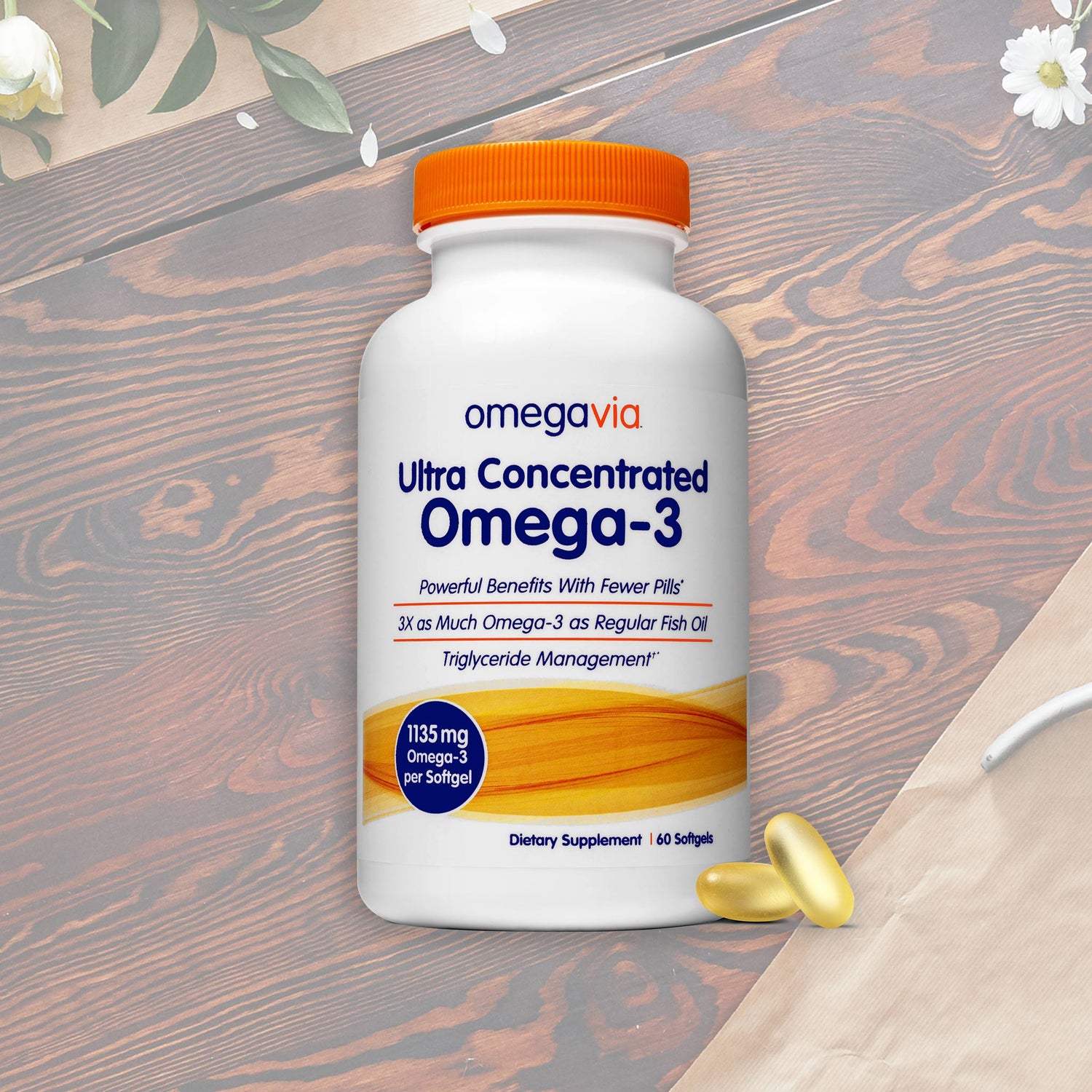
1. Most Omega-3 in a Pill = Results with Fewer Pills

Click image for larger view

Click image for larger view

Amount of Omega-3 in One Softgel

Click image for larger view

Data gathered: October 2012. Formulas may have changed.

* 3rd Party Test Result: Even though the label says 1105 mg Omega-3 per pill, each OmegaVia pill actually has about 1200 mg Omega-3.

Consumer Tip: 1000 mg Fish Oil is NOT the same as 1000 mg Omega-3. Fish Oil contains Omega-3. 1000 mg retail brand Fish Oil typically contains only 300 mg Omega-3. The other 700 mg are fats that your body does not need. Always buy products with at least 75% Omega-3.

fish oil dosage quote

Harvard Medical School. Charles Serhan, a Harvard Medical School expert on Omega-3:

“The kind of benefits seen in most of the clinical trials with Omega-3 generally have involved much higher doses than you see recommended on supplement labels.”


Wall Street Journal. “Fish-Oil Doses Can Be Hard To Swallow,” David Stipp in Wall Street Journal Special Report, January 8, 2008:

“In trials aimed at lowering triglycerides, patients took three grams of Omega-3 per day. You would have to pop a daily dozen of the typical Omega-3 capsules on the market to get that.”

fish oil dosage quote


2. 100% Money-Back Guarantee

Not thrilled? We will cheerfully refund your full purchase price. Even your shipping cost. No need to return your product.

Hassle-free. No questions asked. No time limits.

When you buy online, you can’t touch or feel the product before you buy. We understand. So we respect your right to change your mind after you buy.


3. Independently Certified by 3rd Party for Your Peace-of-Mind

5-Star Quality verified by two different third party labs:


IFOS logo


HIGHEST RATING
View Test Results

Consumer Tip: ask for a certificate of analysis (or ‘C of A’ as insiders call it) to find out exactly what’s in your fish oil supplement.


4. Quality Assured: ZERO Chinese Content

  • Oil is manufactured, purified and tested in USA.
  • Manufactured in an NSF cGMP Certified facility.
  • Softgels are MADE IN USA in an FDA-approved facility.
  • Manufacturing certified by third-party audits.
  • Packaged under cGMP (Certified Good Manufacturing Practices) and Organic standards.

More on OmegaVia Quality & Safety here.

Consumer Tip: more than half of the fish oil pills sold in the United States are made in China or contain Chinese fish oil or gelatin. (It’s cheaper.) Yet they can be legally sold as ‘Made in USA’ because they are bottled in the USA. Make sure you know where your product is made.


5. Safety: Patented Purification Process

  • Uses low-temperature molecular distillation.
  • More Omega-3. No contaminants.
  • Omegavia exceeds standards set by:
    • Global Organization for EPA & DHA Omega-3
    • European Union
    • World Health Organization (WHO)
    • Norwegian Medicinal Standards

More on OmegaVia Quality & Safety here.


6. Value: OmegaVia has Low “Delivered Cost”

  • What is the “Delivered Cost per 1000 mg Omega-3″? The cost to get 1000 mg of Omega-3 delivered to your door. This “insider secret” removes all the marketing and makes it easy to compare products.
  • A couple of brands are cheaper but they don’t use pharmaceutical-grade oil and you don’t get 1000 mg Omega-3 per pill.

Delivered Cost of 1000 mg Omega-3

Click image for larger view
Chart of cost of 1000mg of Omega-3

Consumer Tip: As a smart consumer, you SHOULD compare before buying. But make sure you compare apples-to-apples. Compare brands with 75% or higher Omega-3 with other similar brands.


7. 780 mg of EPA Omega-3 per Pill – the highest of any brand

Why is this important?

  • EPA is more effective than DHA at lowering triglycerides
  • EPA (but not DHA) helps improve mood and depression
  • EPA is a powerful anti-inflammatory for soothing arthritis
  • Our current lot has over 850 mg EPA (but we’re conservative on the label)

Yes, DHA is very important. If you are pregnant, nursing an infant, a child or recovering from brain injury, you will need more DHA than what OmegaVia provides. In which case, buy Nordic Naturals DHA. Otherwise, the 260 mg DHA in OmegaVia is sufficient for adults.


8. Enteric-Coating

OmegaVia has a natural Enteric-coating sprayed on the outside of the softgel capsules.

Enteric-coating does two things:

  • This reduces fishy burps that people hate!
  • It dramatically increases absorption of Omega-3.

How? Enteric-coating prevents the pill from dissolving in your stomach, where there are harsh stomach acids that destroy the delicate Omega-3 fatty acids. Instead, the pills gradually dissolve in the much gentler environment of the intestines.

A New England Journal of Medicine Study comparing enteric-coated and non-enteric coated fish oils show a marked improved in absorption and benefits of enteric-coated fish oil pills.

More about enteric-coating here.


9. AutoShip program (7 out of 10 customers prefer hassle-free AutoShip)


10. Safe for Pets.

Woof! We give OmegaVia to our dogs too.  It makes their coats soft and shiny. And it makes older dogs bounce again. Our product development team worked with 3 veterinarians to make sure that this formula would also work for our 4-legged family members.


And finally…We Made it for Personal Use!

All of us here at OmegaVia take it and give it to our families too. We have worked in the fish oil supplement industry for most of our careers, so we know what to look for. When we developed OmegaVia, we created a formula that we would feel comfortable giving to our families. We hope to include you as part of that extended family.


Share this:
Share this page via Email Share this page via Stumble Upon Share this page via Digg this Share this page via Facebook Share this page via Twitter

{ 101 comments… read them below or add one }

Ferdinand Flores October 18, 2012 at 3:40 am

Question. Can I take fish oil and moringa oleifera at the same time everyday. Because I am currently taking moringa everyday two times a day. I am considering your product and thinking of trying it. Please reply, Thank you,

Reply

Vin Kutty October 19, 2012 at 11:45 pm

Hi Ferdinand – yes, you can certainly take fish oil with Moringa oleifera.
- Vin Kutty

Reply

N. Fi October 23, 2012 at 12:26 pm

Hello.

I would love to buy Omegavia for my family members and myself of course. Dad has high cholesterol & blood pressure, Mum has back-pain etc.

Anyway may i know what’s the source of the gelatin used in Omegavia? Is it Kosher/Halal certified? If it’s a yes, I’ll be on my way to buy a few bottles, that’s for sure. :-)

Looking forward to your reply. Thank you.

Reply

Vin Kutty October 23, 2012 at 7:15 pm

Hi N. Fi – we use beef gelatin and yes, the gelatin is kosher and halal certified.
- Vin Kutty

Reply

Nicole Carnevale October 25, 2012 at 8:53 am

How big are the pills? My children need these, but they can’t swallow large pills. Is there an actual size picture somewhere on your website?

Reply

Vin Kutty October 25, 2012 at 4:06 pm

Hi Nicole – the pills are big. So we strongly recommend against giving the product to kids. That’s the bad news. The good news is that we’re going to launch OmegaVia mini in 2013. That will be kid-friendly.
- Vin Kutty

Reply

Donna December 26, 2012 at 3:27 am

Please let us know when. I have children too and they need this. Thanks..

Reply

William Whitworth October 28, 2012 at 4:01 pm

Why so much more EPA than DHA? In fish, the ratio is the other way, isn’t it?

And which fish are used for your oil?

Reply

Vin Kutty October 28, 2012 at 8:35 pm

Hi William –

It’s not always high DHA in fish. Yes, with Salmon and Tuna, but not all fish.

Here are the reasons why OmegaVia was specifically formulated to have a high-EPA ratio.

How your body uses DHA vs EPA – DHA is a structural compound. Cell membranes are made of it. A very high portion of your brain and eyes are DHA. So it is absolutely crucial to have, especially during pregnancy and early childhood. If you’re not pregnant or a child, then the DHA that you consume stays with you for a few years. One study claims that DHA’s half life is over 2 years, meaning half of the DHA you ate could still technically be in your body at 2 years. DHA becomes a semi-permanent part of your body. You need a lot of it and once you get what you need, you don’t need large quantities of it. Hence the 260 mg of DHA in one OmegaVia pill. EPA, on the other hand appears to be much more transient. It’s not stored by the body for long periods – EPA’s half life is a few days. So there is a much higher turnover of EPA in our bodies. In other words, we may need a lot more of it. DHA is a structural Omega-3. Think of it as bricks to build a house. And EPA is the electricity. Once a house is built, it doesn’t need a lot of bricks. But it needs a regular supply of electricity. That doesn’t mean you don’t need DHA after you’re an adult. You still do, but at much lower levels than you did as a child.

Triglyceride – while both EPA and DHA reduce triglycerides, EPA is slightly safer than DHA at reducing TG and TG-to-HDL cholesterol ratio. This is why new drugs for heart health are all pure EPA or mostly EPA – drugs like Vascepa, EPAdel and EPAnova. Lovaza is a fish oil drug but it has a very high DHA level and the DHA has been pointed at as being the cause of increase in LDL (bad) cholesterol by about 10%. That’s also why these new drugs do not have DHA. High EPA fish oil will do the trick without affecting LDL negatively.

Mood health and depression – even though DHA is required for the brain, once that need has been met, more DHA does not prevent or cure depression. Only EPA seems to have the ability to reduce depression. The largest and most conclusive research on Omega-3 and depression used a very high EPA ratio. DHA is actually contraindicated for depression. Please see our multi-part series on fish oil and depression in our blog section.

Inflammation and Arthritis – EPA is the body’s main anti-inflammatory fatty acid. So if you have joint pain, you need more EPA to counter the inflammation that arises from dietary Omega-6 (corn and vegetable oils.) For curbing inflammation, a very high EPA formula is what works. The reason why we suggest a high-EPA formula for inflammation (joint issues, autoimmune issues, etc.) is that EPA is a ‘feedback inhibitor’ to Arachidonic Acid (AA), a source of several inflammatory cytokines and DHA does not inhibit AA. DHA does not inhibit AA. Most inflammatory pathways start from cytokines derived from the Omega-6 Arachidonic Acid. EPA and Arachidonic Acid (AA) are metabolized by the same enzyme (delta-5-desaturase). So EPA can compete with AA for the enzyme and thus reducing inflammation. The higher the concentration of EPA, the greater the inhibition of the enzyme and so less AA. Followed by less inflammation. This has a lot of impact on several inflammation related conditions from joint health to vascular health. Also, once the body has enough DHA, it can convert excess amounts to EPA to help combat inflammation.

Having said that, a high DHA fish oil is necessary and critical during pregnancy, nursing, childhood and for anyone going recovering from brain, eye or heart surgery, recovering from stoke or head trauma. DHA is also critical if someone is trying to increase fertility. There are some other uses for DHA as well. The 260 mg of DHA in each pill provides all the DHA you’d need every day, while providing a high dose of EPA to address the issues outlined above.

This has become an unintended blog post! I’ll expand on all this in a blog post with references etc.

- Vin Kutty

Reply

Ravin November 21, 2012 at 4:56 am

Dear Vin,

Can I take omagavia and Plavix{ blood thinning} at the same time?

Thanks.
Ravin

Reply

Vin Kutty November 21, 2012 at 9:52 pm

Hi Ravin – please check with your doctor about this. There was a recent study that said combining high dose fish oil with some anticoagulants like Plavix did not increase risk or pose problems. See links below. Still, this is not a decision that you can or should make without your doctor.

Hope this helps.
- Vin Kutty

http://www.ncbi.nlm.nih.gov/pubmed/19801023
http://www.ncbi.nlm.nih.gov/pubmed/17368278

Reply

Arshan November 30, 2012 at 8:16 am

Every day I study about fish oil, and fish oil products on the market for about an hour. I think I know way too much, and I do it because I have a very high TG, and so far I think your product is one of the best, and th fact that you are answering people’s comment is amazing. Thank You.

Reply

Vin Kutty November 30, 2012 at 6:38 pm

Thank you, Arshan.

Reply

Jane December 3, 2012 at 8:30 am

Would I be able to stop taking Crestor if I start taking Omegavia?
Currently my total Cholesterol is 179. My triglycirides were 199 I think. The LDL and HDL were within the normal ranges but LDL was just under.

Thank you

Reply

Vin Kutty December 4, 2012 at 12:42 am

Hi Jane – this is a question that only your doctor can answer for you. Fish oil does not reduce total cholesterol. That may surprise you, but that’s not how fish oil works. Fish oil reduces risk by reducing triglcyerides and reducing inflammation. And also by allowing cells to function properly. You may want to read these two blogs that I wrote:
http://www.omegavia.com/fish-oil-cholesterol/
http://www.omegavia.com/cholesterol-when-to-panic/

For what it’s worth, a total cholesterol of 200-220 is quite normal for women over 40. Cholesterol by itself is not very predictive of future heart events…but triglycerides and HDL are. Divide your TG by HDL. If the number is higher than 3 then it’s time to talk to your doctor and to reduce sugar and starch consumption. There is a little more detail in the blogs links above.
- Vin Kutty

Reply

Mike January 8, 2013 at 2:28 am

what kinds of fish oil is in your pills ?

Reply

Vin Kutty January 8, 2013 at 6:28 pm

Hi Mike – we use Alaskan Whiting and Pollock. It is 100% Alaskan fish, monitored by USDA officials and it is Marine Stewardship certified sustainable.

Reply

Nancy Fussell March 2, 2013 at 11:49 pm

Then this would mean those of us allergic to tuna and salmon and cod CAN take this supplement? My Dr has recommended taking omega 3 in the past but because of the allergies he ruled it out as contra-indicative for me. But if it is of different fish oils I CAN take it without a problem!!!!!
He suggested 95% potency, Enteric coating, IFOS certification AND with vit D in each. Does yours meet all of these criteria?
I also take Plavix as a blood thinner and have multiple chronic health conditions.
If I can take this and help improve things it excites me! Please advise.

Reply

Vin Kutty March 5, 2013 at 5:20 pm

Hi Nancy – not necessarily. If you’re allergic to those fish, you may still be allergic to the fish in OmegaVia. Do not take the product without doctor supervision. Sounds like your doctor watched Brenda Watson’s PBS special: http://www.omegavia.com/brenda-watson-omega-3-and-vitamin-d/ See more on the requirements your doctor mentions in that link.

- Vin Kutty

Reply

ice January 14, 2013 at 12:00 am

Please let me know if the mini fish oil for kids is already in the market…
Thank you

Reply

Vin Kutty January 14, 2013 at 1:01 am

Hi Ice – we are busily working on OmegaVia Mini as of this comment reply in mid January. Stay tuned!

Reply

Joe January 21, 2013 at 6:54 am

@ ice
Gnc sells mini gels with high EPA/DHA. 714/288 mg. it’s good but its expensive.. hopefully Omegavia get them out soon so we all can get some at cheaper price.

Reply

munna January 16, 2013 at 12:18 am

so is there enough dha in it for a nursing mother and why is that critcal for a nursing mother

Reply

Vin Kutty January 16, 2013 at 7:14 pm

Hi Munna – if you take two OmegaVia capsules, you will get enough DHA for a nursing mother. Nursing mothers need DHA for two reasons:

1) the mother’s DHA stores will be diverted to the baby’s developing brains and organs, so the mother is usually deficient during pregnancy and after child birth
2) the baby’s brain does most of its growing just before birth and for the 2 to 3 years after birth and the brain requires a lot of DHA for proper development.

- Vin Kutty

Reply

Sunny January 16, 2013 at 1:10 am

Hi Vin -

Thanks for the info on Omega 3. I know you have touched upon this already (Omega 6). But how do you feel about Omega 6 (specifically GLA) supplement such as Borage oil or EPO. I have heard these are beneficial for PMDD and severe PMS. This assumes other Omega 6 is minimized in the diet.

Thanks

Reply

Vin Kutty January 16, 2013 at 7:37 pm

Hi Sunny – whoa, no simple answer to this question, but I’ll try…

GLA is a potentially good Omega-6. I say ‘potentially’ because GLA lies at the fork in the road, so to speak, of fatty acid metabolism. GLA is converted to DGLA and that can be converted to ‘good’ eicosanoids. This is really complex stuff, so attempting to publicly simplify this is…umm…probably not a good idea. So, kids, don’t try this at home.

If GLA is not converted to DGLA, then it can get converted to AA and that can cause all kinds of bad stuff to happen. Several factors, including gender, affect how GLA handles this fork in the road. So blindly taking Borage or EPO oil to reduce PMS or PMDD symptoms may backfire and actually increase AA levels instead of DGLA levels. That’s what I meant by ‘kids don’t try this at home.’ Our entire legal dept just keeled over dead from reading this, with Xs instead of eyes.

One way you can influence how GLA handles the fork in the road is with EPA. More EPA = greater inhibition of delta-5-desaturase enzyme required to convert DGLA into AA. So a high EPA + moderate GLA regimen in combination with a low-Omega-6 diet has the potential for improving PMS and PMDD symptoms as well as several other chronic disease. At least theoretically.

Are you sorry you asked? :-)

- Vin Kutty

Reply

vin volmut January 25, 2013 at 6:44 pm

Hi Vin,
We hear so much about Krill oil being a wonderful new fish oil. It is also a very expensive product. My Krill oil says only 50mg EPA, 20mg DHA. Looks like I should be eating a lot of these to get a benefit. Why do you use white fish and not Krill? Thanks in advance.

Reply

Vin Kutty January 25, 2013 at 10:08 pm

Hi Vin – krill oil is wonderful, assuming you take 10 or 20 pills a day. I’m glad you read the back of your krill oil label – that’s where the truth is hidden – the tiny amount of Omega-3.

We don’t use krill oil because you’ll need a zillion pills a day to get the benefits you want. Yes, it is better absorbed than fish oil, but what good does better absorption do if there is only a tiny bit of Omega-3 in it? OmegaVia was started to give you the benefits of Omega-3 with the least number of pills – using krill oil would be going the other way.

- Vin Kutty

Reply

vin volmut January 25, 2013 at 6:46 pm

Vin, One more thought, If these fish oils can suppress depression, what if anything can it do for dementia? I, like many people know someone going through this horrible condition. Thanks again!

Reply

Vin Kutty January 25, 2013 at 10:15 pm

Hi Vin – dementia and depression have different pathologies. They’re connected but not the same. From what I’ve read, preventing dementia requires dietary intervention years, if not decades, before it starts, plausibly starting with elimination of sugar and processed foods when you’re still in your 20s and 30s. Taking Omega-3 after onset of dementia may not reverse the problem. It can’t hurt. But if Omega-3 can prevent dementia, it probably needs to be taken through food or supplement long before symptoms start.

Sorry – probably not what you wanted to hear. But it’s worth going back to an ancestral or paleo type diet with only vegetable, fruits, grass-fed meats, seafood and nuts. This leaves out 95% of what most grocery stores sell.

- Vin Kutty

Reply

stacy February 2, 2013 at 9:52 pm

i am currently on tricor and i was wondering if this would be a good alternative? because i do not have the funds for the medicine anymore.

Reply

Vin Kutty February 3, 2013 at 8:08 pm

Hi Stacy – OmegaVia or any other pharmaceutical grade fish oil is not an alternative for Tricor. One is a drug and the other is an essential nutrient.

Tricor reduces both cholesterol and triglycerides. Omega-3 reduces just triglycerides. Granted fibrate drugs like Tricor are not the most effective at lowering blood fats, it may be a well-thought-out decision made by your doctor based on several factors, including side effects of other cheaper drugs, your health history etc. So do not discontinue this drug or any other drug without checking with your doctor.

You can certainly take fish oil with Tricor, but don’t switch one for the other without talking to your doctor.

- Vin Kutty

Reply

Violet R Cartledge February 7, 2013 at 10:55 am

what is the difference between omega 7 and omegavia?

Reply

Vin Kutty February 11, 2013 at 7:30 pm

Hi Violet – Omega-7 is another rarely occurring fatty acid. It is found in small quantities in macadamia nuts and sea buckthorn. Omega-7 has some anti-inflammatory benefits but the scientific proof/results are still trickling in. Omega-7 is not found naturally in fish oil. At least not in significant quantities. OmegaVia is highly concentrated for two Omega-3 fatty acids, namely EPA and DHA. So OmegaVia does not contain measurable amounts of Omega-7.

- Vin Kutty

Reply

RWM February 18, 2013 at 10:28 pm

1. How many mgs is the OmegaVia gel cap?
2. What is the EPA content (mgs) in each gel cap?
3. What is the DHA content (mgs) in each gel cap?
4. What is the “other” content (mgs) in each gel cap, and what does that “other” component consist of?
5. How many gel caps in a bottle, and what is the cost per bottle?

Reply

Vin Kutty February 19, 2013 at 1:22 am

Hi RWM –

Each OmegaVia capsule contains 1300 mg of oil.
Each capsule contains 780 mg of EPA Omega-3
Each capsule contains 260 mg of DHA Omega-3
The ‘Other Omega-3s’ are potentially beneficial Omega-3 that often go unaccounted for. These can easily be converted to EPA Omega-3 in your body and can provide benefits.
60 capsules per bottle.
Cost depends on how many bottles you buy. As low as $24.74 to as high as $29.74.

Reply

RWM February 18, 2013 at 10:33 pm

Can OmegaVia be substituted for Lovazza to lower triglycerides, since the primary active ingredients in both are EPA and DHA.

Reply

Vin Kutty February 19, 2013 at 1:25 am

Hi RWM – we have thousands of customers who use OmegaVia for exactly this purpose. Due to FDA regulations, we are not allowed to directly answer your question. But I suggest you read this: http://www.omegavia.com/testimonials/

Reply

RWM February 19, 2013 at 3:28 pm

Based upon the information you provided (each OmegaVia gel cap contains 1300 mgs of oil, 780 mgs of EPA, and 260 mgs of DHA), am I correct that the composition of the rest of the gel cap is what is normally classified as “other,” amounting to 260 mgs?

Am I also correct that the percentage of EPA/DHA in each OmegaVia gel cap is 80% of the total composition of the pill?

Reply

Vin Kutty February 19, 2013 at 11:09 pm

Hi RWM – Each capsule contains 1300 mg of oil. This is irrelevant and that’s why we don’t mention it on the product label. What’s relevant is the amount Omega-3 in that oil. There is a minimum of 1105 mg of Omega-3 per capsule. Of the 1105, 780 is EPA, 260 is DHA and 65 is ‘other’ Omega-3.

Total Omega-3 is about 90%. Usually higher, but we round down to 90. There is batch to batch fluctuation – this batch was at 96%, but we don’t guarantee it will be that high with the next batch. We always claim less than what’s on the label. Third-party lab test results are here: http://www.ifosprogram.com/files/IFOS%20Innovix%20OmegaVia%20Batch%20S2A042.pdf

- Vin Kutty

Reply

RWM February 20, 2013 at 6:53 am

I don’t consider “other” when computing the benefits of an omega-3 product. Indeed, I think its inclusion in the computation is misleading and skews the results. I consider EPA and DHA the important factors. I try to compute the percentage of EPA/DHA in each gel cap. Normally, I am able to do this, but I am having trouble doing it accurately with OmegaVia because of the published information on the label. However, according to your statements here, and the third party IFOS results, the percentage of EPA/DHA in each gel cap is at least ninety percent (in fact, according to my computation, the IFOS batch results would place it at 93.8%). This would probably place OmegaVia as the product with the highest concentration of EPA/DHA currently on the market, prescriptive or non-prescriptive. Is this a fair assessment, and if it is, shouldn’t this be clarified on your label?

Reply

Vin Kutty February 21, 2013 at 7:21 pm

Hi RWM – you should consider ‘other’ Omega-3s because most of those Omega-3s like DPA, SDA are easily converted to EPA in the body. In most fish oils, the amount of these other fatty acids is low, but in highly concentrated oils, it can be a significant amount. So I wouldnt discount it completely.

You are right, according to IFOS, this batch is about 94%. Another more detailed assay by IFOS said 96%. Yes, it does make OmegaVia one of the highest concentration products on the market. If you know of any with higher levels, please let me know. We dont make a big deal out of this, but I suppose we should! :-)

- Vin Kutty

Reply

RWM February 21, 2013 at 10:22 pm

Do you recommend that OmegaVia omega-3 be taken with CoQ10? Do they complement one another, or are they largely duplicative of each other? If so (complementary or duplicative), how so?

Reply

Vin Kutty February 21, 2013 at 11:47 pm

Hi RWM – CoQ10 is always better absorbed with taken with other oils or meals. So taking it with fish oil and a meal will increase its low absorption. But do you need CoQ10 – may be. If you are taking statins drugs, then, definitely, yes. If not, CoQ10 is a good antioxidant and something to take to keep your heart muscles powered up.

Other than that, there is no synergy and do not compliment each other.

- Vin Kutty

Reply

Hughes February 24, 2013 at 9:21 am

Hi..

A few members of my family are suffering from High triglycerides , weak joints etc..and also a friend of mine suffers from depression..

Kindly answer the following which my family and also my friends wanted to know so that i can immediately order a few bottles!!…..:-)

Is the beef gelatin that you use in omegavia Kosher certified or Halal certified?? Kindly mention the organisation which has certified it as Kosher and Halal?

Is the Glaze that you use made of Shellac which is dissolved in Alcohol?..

Do email me too..

Thank You

Reply

Vin Kutty February 24, 2013 at 7:55 pm

Hi Hughes – the beef gelatin is both Kosher and Halal certified. The Halal certification is by the German certification authority, Islamiches Zentrum Aachen. The product uses gelatin from GELITA USA and the certificate number is 01-01-13. The glaze is not shellac. It is based on plant cellulose.

- Vin Kutty

Reply

RWM February 24, 2013 at 6:09 pm

Omega-3 pills seem to have four categories of ingredients: EPA, DHA, “other,” and whatever else is left over. What comprises “other,” and what is the left over stuff?

Reply

Vin Kutty February 24, 2013 at 8:05 pm

In OmegaVia the left over stuff is about equal parts Omega-6, monounsaturated fats (Oleic) and various other saturated fats. About 1 to 2 percent each.

- Vin Kutty

Reply

RWM February 24, 2013 at 9:10 pm

What about the “other” category. What does that consist of?

Also, what is the ideal ratio of EPA to DHA I should be looking for? Personally, I’m more interested in the EPA component than the DHA component.

Reply

Vin Kutty February 24, 2013 at 9:59 pm

Ideal EPA to DHA ratio depends. For inflammation and mood benefits, you’re better off with EPA. If you’re pregnant and/or nursing, then DHA.

- Vin Kutty

Reply

RWM February 25, 2013 at 4:30 am

Is OmegaVia kosher or hallal?

Reply

Vin Kutty February 25, 2013 at 9:39 pm

Hi RWM – the gelatin used is both kosher and halal.

Reply

RWM March 5, 2013 at 12:49 am

I understand, but is OmegaVia CERTIFIED Kosher and Halal?

Reply

Vin Kutty March 5, 2013 at 10:21 pm

Hi RWM – no. OmegaVia is not certified Kosher and Halal. Only the gelatin is. We have made this clearer on the new labels we are currently printing.

- Vin

Reply

RWM February 25, 2013 at 4:36 am

I have noticed that high quality omega-3 in liquid form has very high EPA/DHA numbers per teaspoon full, i.e., 3000 mgs per spoonful. Is this something that OmegaVia offers or is considering?

Reply

Vin Kutty February 25, 2013 at 9:53 pm

Hi RWM – we don’t have a liquid dosage form. I don’t want to say that we will never do so, but it is unlikely that we will do so in the near future. The reason is that liquid oils are triglyceride form because they are relatively pleasant tasting. We specialize in ultra-concentrated oils and concentrated oils are almost always ethyl ester forms and EE form oils don’t taste that good. TG forms are usually not very concentrated but even with their low concentration, a teaspoon can hold a lot more volume than a capsule can, hence the high amount of Omega-3 that you get per teaspoon. My suggestion to most people is that if you can handle the taste of a liquid fish oil, you are MUCH better off taking liquid than capsules – lots of Omega-3 and it costs so much less.

- Vin Kutty

Reply

RWM February 26, 2013 at 4:40 pm

Vin, kudos to you for your candor in that response.

I am familiar with a company that manufactures high quality liquid and gel cap omega-3. They say that one teaspoon full of omega-3 liquid is equal to five 1000 mg gel caps of omega-3. I did the math and that’s about right for their products. (By extrapolation, their teaspoon full is equal to about 3000 mgs of omega-3 and one of their 1000 mg gel caps has about 600 mgs of omega-3, ergo, five to one.

This is one reason why OmegaVia, with its 1217 mgs of omega-3 (per the IFOS test batch result) per 1350 mg gel cap, caught my attention!

Reply

JUNAID February 26, 2013 at 1:12 pm

hello vin,
i suffer from internally dry skin ,,i have heard much about fish oil,,i started taking fish oil 3 softgels of amway s salmon omega,and 2 tbsp of flaxseeed,,last year ,,i found a dramatic improvement inmy skin hydration and feel after 20 days,,this improved state stayed for 20 days ,,and after which my skin returned to being dry again,i have been taking fish oil for one year ,,and developed neuropathic pain due to it,,i really want to solve my internally dry skin problem ,,please guide me whether ur omegavia product wid high epa content can help?
waiting for ur reply
thank you

Reply

Vin Kutty February 26, 2013 at 8:03 pm

Hi Junaid – the fact that your skin improved initially tells me that Omega-3 helps. But I am willing to bet money that you are consuming too much Omega-6 from vegetable oils. If you can eliminate vegetable oils completely from your diet, you will notice that your skin and many other health markers will improve. I have not heard of anyone getting ‘neuropathic pain’ after 1 year of taking fish oil.

OmegaVia may be able to help, but no supplement can outrun a bad diet.

- Vin Kutty

Reply

Lesley February 27, 2013 at 9:38 pm

As UK import tax would almost double the cost of your product I looked for a comparable UK based product – & cannot find one! The highest EPA per cap I can find ( after a few hours searching) is marketed by this company http://www.mind1st.co.uk/. I thought some of the claims they are making may be of interest to you:

“How does your clinical grade Pure EPA Omega 3 fish oil compare to other supplements? The simple answer is, it doesn’t, you have come right to the very top of the tree in terms of strength of concentrate and purity. It doesn’t compare to cod liver oil (weakest oil around) health food shop omega oil (second weakest) or even pharmaceutical grade fish oil (third weakest) this omega3 fish oil will do everything you want it to do because it is clinical grade!!! And it is quite simply the strongest and cleanest omega 3 oil money can buy” and………..”Quite simply the strongest concentrated EPA fish oil on the world market”

Now, unless I have misunderstood the information on your website, it seems to me the above statements are just not true? Whilst I assume it is hardly worthwhile your ‘challenging’ the statements made by this company I would be interested to hear what you think about the inclusion of ‘Borage Oil’.

Have you any plans to distribute directly in the UK/EU any time soon?

Regards
Lesley

Reply

Vin Kutty March 1, 2013 at 6:29 pm

Hi Lesley – you may purchase small quantities of OmegaVia (3 bottles or less) for personal use and we ship directly to you without taxes.

The Mind1st product in UK seems like a good product. Their claims are, shall we say, strong! Since the marketing language associated with dietary supplements are not 100% govt regulated, companies say and do a lot of ‘funny’ things. Our legal dept keeps tabs on these developments but we do not act on them unless absolutely necessary.

GLA found in borage oil is often a good thing as GLA can be converted to DGLA, which can in turn be converted to several anti-inflammatory compounds. But taking GLA every day is not a good idea, as there can be some ‘feedback inhibition’…difficult subject to address here.

- Vin Kutty

Reply

RWM March 3, 2013 at 10:59 pm

Vin, is there a testing facility that rates CoQ10 products, the way IFOS rates omega-3 products? If so, what is it?

What are your top three choices for CoQ10, including both liquid and gel cap?

Reply

Vin Kutty March 5, 2013 at 9:52 pm

Hi RWM – I am not aware of a CoQ10 testing facility. ConsumerLab.com is the closest thing I can think of. They will charge membership to view test results. What I always tell people is that 90% of CoQ10 is probably Chinese. The other 10% is made in Japan or by Japanese in Texas – Kaneka. If you can find the Kaneka cobranded products, at least you know that the quality is top notch. But there no no guarantee that even if Kaneka CoQ10 is used, that the right amount claimed on the label is present…fortunately, this is rarely an issue. Unlike fish oil prices, CoQ10 prices are dropping, so there is less incentive to adulterate or skimp on capsule fill. Having said all that, there is very little quality or potency stratification in the CoQ10 products and most are fine. As far as liquid products, Qunol is fairly good.

- Vin Kutty

Reply

RWM March 3, 2013 at 11:15 pm

Vin, what are your top three choices for astaxanthin?

Does OmegaVia have any intention of entering the CoQ10 field?

Reply

Vin Kutty March 5, 2013 at 9:57 pm

Hi RWM – I use Costco’s Trunature brand astaxanthin. It’s not an endorsement, but just want I’m using right now. Look for BioAstin or AstaReal sub-brands – these are OK. Not sure I have favorites.

At some point, may sell a ‘heart health pack’ that could contain CoQ10, but we will not be selling CoQ10 by itself or adding to fish oil.

- Vin Kutty

Reply

Jim March 8, 2013 at 11:09 pm

Hello:

I would really like to try your product but I’ve tried so many and spent so much money only to be let down. Can you tell me if your product contains krill oil? I’m currently taking krill oil pills now and they haven’t done a thing. But I was told that the krill oil is the best. I suffer with asthma and thought krill oil would help. Can you advise me on this please? I really need help! Thanks

Reply

Vin Kutty March 11, 2013 at 11:56 pm

Hi Jim – OmegaVia does not contain any krill. I suspect that your krill oil didnt do anything is because you followed their dosage instructions. Most krill oil package dosage instructions say take 1 or 2 pills per day – that’s the marketing. The reality is that you still need about 1000 mg of Omega-3 for krill oil to give you noticeable benefits. 1000 mg of Omega-3 is usually about a dozen pills a day. If you keep up that dosage for a couple of weeks, you will begin to notice benefits and your wallet will be a lot skinnier. Don’t fall for the marketing.

- Vin Kutty

Reply

RWM March 9, 2013 at 7:42 am

Vin, I take high potency omega-3, CoQ10 Ubiquinol, and astaxanthin. I’m not sure where the benefits of one leave off and the benefits of the others begin.

How do these three supplements interact, and is it really beneficial to take all three?

In other words, what does each contribute to the mix?

Reply

Vin Kutty March 12, 2013 at 12:00 am

Hi RWM – you don’t need to take all three together. We’ve talked about Omega-3 enough. CoQ10 is not necessary (but it’s a nice antioxidant) unless you’re taking statin drugs or you have diagnosed heart disease. Astaxanthin is also a great antioxidant. Good for your skin because it gets deposited in your skin and protects from UV exposure. It is technically possible that CoQ10 and astaxanthin help the Omega-3 from rancidity or oxidation. Otherwise, no need to combine the three.

- Vin Kutty

Reply

Dena March 9, 2013 at 9:00 pm

Does your fish oil contain vitamins D. Is it necessary? I’m allergic to any animal with fur. That includes beef. Can I take this pill?

Reply

Vin Kutty March 12, 2013 at 12:11 am

Hi Dena – no, OmegaVia does not contain Vitamin D – pleas see this: http://www.omegavia.com/brenda-watson-omega-3-and-vitamin-d/ Vitamin D absolutely DOES NOT have to be mixed with fish oil for it to be absorbed.

Vitamin D is essential but fortunately, your skin can make plenty of it if you get some sun every day in the summer. If you are allergic to beef, you need to know that our gelatin is made from beef. You need to talk to your doctor before taking OmegaVia.

- Vin Kutty

Reply

FAM March 11, 2013 at 3:04 pm

Hi Vin,
Does OmegaVia only sell softgels? I was looking for fish oil in a bottle.

Reply

Vin Kutty March 12, 2013 at 12:38 am

Hi FAM – yes, we only sell softgels.

- Vin Kutty

Reply

RWM March 12, 2013 at 10:51 am

Vin, what is the soy and GMO content of OmegaVia?

What is the significance of GMOs in an omega-3 product?

Reply

Vin Kutty March 13, 2013 at 3:16 am

Hi RWM – there is 3IU of Vitamin E in each pill of OmegaVia that is derived from soy. It is extremely purified, so there is virtually no proteins to react to. But if you are soy-allergic, then I’d proceed with caution, with your doctor’s supervision. Any GMO content in OmegaVia would come from that portion of Vitamin E. Typically, fish oil are not considered GMO for this reason, but just about every fish oil contains some Vitamin E added as an antioxidant, and I don’t think any of that Vitamin E is non-GMO.

- Vin Kutty

Reply

RWM March 15, 2013 at 7:01 pm

Bottom line, then, would it be correct to conclude that OmegaVia contains both soy and GMOs?

Reply

Vin Kutty March 16, 2013 at 9:24 pm

Hi RWM – I feel like I’m on the stand! Put that way, yes.

- Vin Kutty

Reply

RWM March 18, 2013 at 7:40 pm

Sorry, Vin, it probably has something to do with what I do for a living.

Thanks for the candor!

Jim March 19, 2013 at 8:15 pm

Good Afternoon; I was reading that this product is good for inflammation. I have asthma and most times have a very difficult time just climbing a flight of stairs.

Does your product help with Asthma? I have tried so many other things that I’m all spent out. But I’m willing to try your product if it will assist me with breathing. Thanks

Reply

Vin Kutty March 21, 2013 at 6:58 pm

Hi Jim – a lot of our customers take OmegaVia to help manage inflammation. And our high-EPA levels provide a lot of help in that regard. Asthma is not a condition that should be self-medicated, so you should definitely consult with a doctor if you have not already done so. But asthma is strongly associated with inflammation and Omega-3 helps reduce inflammation. And inflammation is strongly correlated with high Omega-6 diets that are rich in vegetable seed oils. Is Omega-3 worth taking in your case? Absolutely. Will it cure asthma? Probably not, without medication and a change to low-inflammatory diet. It has to be a multi-pronged approach that includes medications, supplements and diet.

- Vin Kutty

Reply

Mark March 20, 2013 at 3:24 am

Hello. Thanks for the informative article. I have a question though regarding to the enteric coating. You say that “A New England Journal of Medicine Study comparing enteric-coated and non-enteric coated fish oils show a marked improved in absorption and benefits of enteric-coated fish oil pills.”

I read the journal article, and it doesn’t compare enteric-coated fish oils with non-eneteric coated fish oils. Rather, it compares enteric-coated fish oil capsules with enteric-coated placebo pills. (“The patients were randomly assigned to receive either three enteric-coated capsules of fish oil three times daily or three enteric-coated capsules of identical appearance containing 500 mg of placebo three times daily.”) The article concludes that the fish oil capsules showed benefits over the placebo pills, but did not compare coated capsules to non-coated capsules whatsoever.

The article does not test the effectiveness of the enteric coating, so how can you claim that the journal article supports the assertion that enteric coatings improve the absorption and benefits of fish oils?

Reply

Vin Kutty March 21, 2013 at 7:16 pm

Hi Mark – the ‘marked improvement’ in the NEJM paper was when compared to Belluzzi et al from 2 years earlier in 1994. http://www.ncbi.nlm.nih.gov/pubmed/7995183 Same lead author for both papers.

They concluded in the NEJM paper that with the enteric coated delivery form, ‘the dose needed to achieve the incorporation of fish-oil fatty acids into phospholipid membranes is one third of that used previously’ in the 1994 study.

- Vin Kutty

Reply

Mark March 22, 2013 at 3:51 am

Hello Vin. Thanks for the quick response! You are correct… they do state that in the paper. I missed that. My mistake.

They don’t seem to justify the claim, though. It appears to be somewhat of an aside comment that’s outside the main scope of the experiment being report. Are you familiar with the researchers? Do you know how they came up with the “one third” number? If that’s correct, it is quite substantial.

It looks like they used a synthetic coating (“Eudragit NE 30D”), which resists gastric acid for 30-60 minutes. Would the OmegaVia coating be similar in terms of resisting stomach acid? Thanks!

Reply

Vin Kutty March 23, 2013 at 12:30 am

Hi Mark – I too wish they’d gone into that in greater detail, but they didn’t. It is a substantial increase and it ought to be further explained/explored. Eudragit is a synthetic methacrylate copolymer. OmegaVia does not use that, instead, uses a natural cellulose-derived enteric coating that also works by resisting gastric acid. Both types of coating perform similarly.

- Vin Kutty

Reply

RWM March 20, 2013 at 2:35 pm

Vin, I noticed that OmegaVia has, roughly, a 3 to 1 ratio of EPA to DHA. Is that something OmegaVia planned and can adjust one way or the other, and if so, how did the company arrive at that ratio?

Also, do some omega-3 oils have no “other” component, or do all omega-3 oils have at least some “other” component?

Reply

Vin Kutty March 21, 2013 at 7:50 pm

H RWM – we prefer to have anything from 3 to 1 to 5: 1 ratio on a daily basis. Since a lot of fish have 1.5 to 1 ratio, making 3 to 1 is expensive. Making 5:1 is even more expensive. So the 3:1 was a compromise between what we REALLY wanted and what’s affordable to most people. Having said that, we’re working on launching an EPA-only product, so the ratio would be 100+ to 1…cost be damned?

All fish oils have ‘other’ fats and other Omega-3s. Higher the purity, the less of the other stuff you’ll have in there.

- Vin Kutty

Reply

RWM April 4, 2013 at 1:12 pm

Hi, Vin:

Where do you see the market for a 100+ to 1 EPA/DHA omega-3 product? What would be the profile of a person who would likely take such a pill? I assume it would be a 1350 mg gel cap or would this be a liquid?

Reply

Vin Kutty April 4, 2013 at 7:13 pm

Hi RWM – I prefer to call these EPA-only formulas and I think they are going to become popular with ‘highly informed’ Omega-3 users. Inflammation and mood management would be the top benefits of such a product. Could also be used for triglyceride management. There is a new drug called Vascepa that’s EPA-only fish oil and its used for lowering triglycerides. The down side is that these oils are very expensive – about twice as much as regular oils of equal strength and mix of EPA/DHA. Using chromatography to remove the DHA is not cheap. But it can be done and it’s a very safe and clean technology. These products will not be in a liquid form – high potency ethyl esters don’t taste that good.

- Vin Kutty

Reply

RWM April 11, 2013 at 10:15 am

Hello, Vin.

It looks like Amarin plans to market Vascepa primarily for the lowering of triglycerides. I would assume its success may be dependent upon comparsons with Lovaza, both from an effectiveness standpoint and a price standpoint.

Apparenly Amarin is very optimistic about Vascepa, judging by its projections.

I could see a market for this, but I would have to be convinced: (1) that the higher EPA ratio is really beneficial for mood management, inflamation, and triglycerides reduction, as compared with more conventional omega-3 supplements; (2) it makes serious inroads into Lovaza in terms of triglycerides management; and (3) the price is not outrageous. Pricewise, “twice as much” doesn’t seem like a scary number, especially when compared with Lovaza.

Does all of this mean that a case can also be made for a high ratio DHA supplement?

Reply

Vin Kutty April 11, 2013 at 5:04 pm

Hi RWM – the data for EPA Omega-3 and mood management and inflammation is fairly clear. More here: http://www.omegavia.com/why-omegavia-is-high-in-epa-mood-benefits/ and here: http://www.omegavia.com/why-omegavia-is-high-in-epa-omega-3-part-1/

Data on EPA and triglycerides is what Vascepa is based on. Amarin can argue the case much better than I can, after all, they are a publicly traded pharma company with one FDA-approved product for lowering triglycerides.

I have no idea what Vascepa costs, but I can promise you that the oil going into Vascepa is a LOT more expensive than the one going into Lovaza.

A high-DHA supplement makes sense for select conditions like pregnancy, people recovering from stroke, head injury and possibly a few other things. Otherwise, a little bit of DHA goes a long way. http://www.omegavia.com/why-omegavia-is-high-in-epa-omega-3-dha-and-your-brain/

Reply

RWM April 12, 2013 at 11:04 am

Vin, re:

“[T]he data for EPA Omega-3 and mood management and inflammation is fairly clear.”

What about the data for EPA Omega-3 and the lowering of high triglycerides via a high EPA formula, the approach Amarin seems to be taking?

“I have no idea what Vascepa costs, but I can promise you that the oil going into Vascepa is a LOT more expensive than the one going into Lovaza.”

If I understand you clearly, are you saying that, in your opinion, the high EPA omega-3 oil in Vascepa costs more to produce than the omega-3 oil in Lovaza, yet the price of Lovaza costs far more on the retail market? If I understand you correctly, then it would make sense for Amarin, or any other prospective manufacturer of high EPA omega-3 oil, to launch a frontal attack on Lovaza, highlighting, among other things, that Vascepa, or any other similar high EPA omega-3 oil product, is non-prescriptive.

Reply

Vin Kutty April 14, 2013 at 12:31 am

Hi RWM – the data for EPA-only formulas and triglyceride reduction certainly exists. But DHA reduces triglycerides almost as well. The reason why Vascepa exists is what I call ‘LDL-phobia.’ DHA tends to increase LDL cholesterol a little bit. People (and doctors) are scared of LDL. But LDL can be good or bad – we don’t know if DHA increases what they call ‘LDL-P particle numbers.’ See my blog about it here: http://www.omegavia.com/why-omegavia-is-high-in-epa-omega-3-ldl/

Yes, the oil that goes into Vascepa is far more expensive than the oil that goes into Lovaza. What you are suggesting is exactly what Amarin is doing…and about a dozen supplement companies have EPA-only products in their pipeline.

Reply

Eric April 16, 2013 at 8:31 pm

Based on the FDA’s FAQ they do not approve facilities? I was unable to locate your company in the FDA Database as well…

http://www.fda.gov/ForConsumers/ConsumerUpdates/ucm047470.htm#companies

Can you provide more clarification as to your FDA Approved Facility really means?

Reply

Vin Kutty April 17, 2013 at 5:07 pm

Hi Eric – you are technically correct and so is the FDA is saying that they don’t approve facilities or companies or supplement products. FDA does not hand out a certificate of approval for facilities. But they have certainly dropped by unannounced every year or two and stay for 3 or 4 days. They inspect every quality control document and process, standard operating procedures, record keeping, validation of analytical methods, employee training certificates, etc. The list goes on.

If our facilities are not approved, we will get something called a ’483′ in FDA lingo. This is basically a list of violated regulations. We are then given a few days to make corrections and respond back in writing. If our response is inadequate, then they would issue a public ‘warning letter.’ All of our facilities have been inspected, more than once, and we have not received any 483s or warning letters. We interpret this in two ways: 1) our facilities are acceptable to FDA inspectors and 2) we are unofficially ‘FDA Approved.’

Of course, our fortunes can change depending on the mood of the FDA inspector or how that inspector interprets the regulations…not unlike when a cop pulls you over for speeding.

Reply

Sam May 4, 2013 at 9:35 am

Hey Vin,

You’ve probably heard of these guys: Icelandic Fourmula [sic].

They seem to list how they are better than OmegaVia in several different categories.

Please comment and refute. I want to know Omega Via is THE BEST.

Also, separately, can the pills be opened and spread over food, or is that not a good idea?

I am asking because I am concerned over the size of the pill. Do you have the measurements of an individual pill?

Thanks,

Sam

Reply

Vin Kutty May 4, 2013 at 8:05 pm

Hi Sam – yes, I are aware of the brand and our management is aware of their misrepresentation of OmegaVia expressed here: http://icelandicfourmula.com/omegavia-vs-iceland-omega-3-iceland-fish-oil.php

A few points:

  1. Quadruple Strength – there is no official definition of Triple or Quadruple Strength fish oil, but one assumes Quad would have more than Triple. Triple Strength formulas typically have 900 mg of Omega-3 per pill. Icelandic formula has 600 mg Omega-3 per pill. Their Omega-3 numbers on the label are based on 3 pills.
  2. Pharmaceutical grade fish oil – again, there is no strict definition for this term. If we use Lovaza (pharma product) as a yard stick, then 85% Omega-3 concentration of the oil or higher is pharma grade. We claim 90% purity. Our last batch was at 96% and this batch is 93%. I’m very comfortable with calling OmegaVia a pharmaceutical grade fish oil. Very few products reach 90% purity or higher. Icelandic certainly does not.
  3. Molecularly distilled fish oil – virtually all fish oils these days are molecularly distilled. The only way we can get our concentration that high is thru multiple molecular distillations.
  4. They are right in that OmegaVia is not made with oil from Iceland. The only thing I can agree with.
  5. Doctor recommended – actually 80% of our customers come to us from doctor recommendation. We don’t advertise or call on doctors. Never have. If we did, you’d have to pay more.
  6. Unconditional 30 day guarantee – actually, they are right on this one too. Sorry. We don’t have a 30 day guarantee. We have no time limits on our return policy: http://www.omegavia.com/returning-product/

To directly quote their web page, “When you compare Icelandic Fourmula to Omegavia, the choice is CLEAR!

Indeed.

Choice isn’t always as clear: I really like and often recommend RenewLife’s Norwegian Gold products, Minami Nutrition and Nordic Naturals. Minami and RenewLife have niche products that are great. Is OmegaVia THE BEST? Well, I think so, but you could make a good argument for the brands I just mentioned too.

I would NOT squeeze the oil out of pills and spread on food – capsules are somewhat pressurized and puncturing will squirt droplets to places you’ll never discover and your house will smell after a few days. Concentrated ethyl ester oils are not pleasant tasting like lower-potency triglyceride oils used in liquid fish oils like Nordic’s. Also, once exposed to air, Omega-3 will begin oxidizing – going rancid.

I don’t have measurements of individual pills – the manufacturing guys call it ‘Oblong 24′ but that means nothing to most people. I’d just say it big. But we are coming out with an OmegaVia Mini this summer, probably July/August.

Reply

Sam May 10, 2013 at 4:48 am

I absolutely LOVE how you reply quickly to questions from anyone. So many companies just don’t do that.

Thanks!

Reply

Vin Kutty May 11, 2013 at 9:15 pm

Thanks, Sam. Ironically, I am going to be away from my desk for a week or two, so you may have to take that back! :-)

Reply

Donna May 8, 2013 at 2:44 am

I am a “super” pill swallower and a nurse. I have gotten a pill stuck in my esophagus 3 times already. It HURTS! And I suspect it will cause some erosions. Seriously….can’t you halve the amt in each capsule and I will HAPPILY take 6 pills instead of 3.

Reply

Donna May 8, 2013 at 2:37 pm

Just read about the smaller pill coming. That’s wonderful! Looking forward to ordering

Reply

Vin Kutty May 8, 2013 at 11:18 pm

Hi Donna – I am so sorry! I hate, hate, hate hearing this…and that’s why we’re working night and day to get OmegaVia Mini ready for sale. It will be less than half the size of OmegaVia. We hope to have it ready by July/August.

Reply

Leave a Comment

{ 1 trackback }
