


Editor: this article was written in 2013. Our understanding of DHA’s role in health has changed in that time. Optimal brain health requires more DHA than this piece suggests. More here.
—
Here’s another reason why OmegaVia is high in EPA and low in DHA:
DHA Omega-3 – a little bit goes a long way.
Everyone knows babies need DHA for brain development. Even as adults, there is more DHA in your brain than anywhere else.
There is almost 300 times more DHA in the brain than EPA.
So we should be taking lots of DHA every day, right?
Not really.
Your brain absorbs only about 4 mg of DHA per day.
That’s right. Four milligrams. Per day.
3.8 mg to be exact.
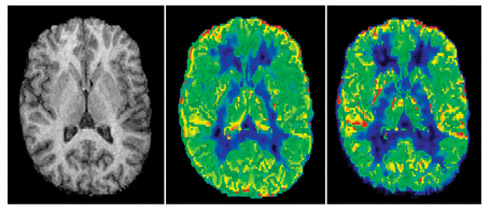
Researchers from Yale and National Institute of Health discovered this in 2009, (whole paper) using positron emission tomography.
C’mon, stop it! That’s the machine they used in Back to the Future!
Would you feel any better if I told you that they used an ‘adaptive fuzzy C-means algorithm’ to compute all this?
Actually, it makes sense when you read the second revelation from the paper:
DHA is very, very long-lasting
DHA has a half-life of 2.5 years or 911 days.
What does that mean, Doc?
It’s the time to use up half of what you started with.
It means that if your brain absorbed 2 drops of DHA today, one of those two drops will have been used up after 911 days. And the other drop would still be in your brain.
Now the 4 mg per day number starts to makes sense.
If your brain can absorb just 4 mg per day and 2 of that 4 mg will still be around after 911 days, then DHA really is long-lasting.
This is a key difference between EPA and DHA: DHA is a structural Omega-3 while EPA is a functional Omega-3.
If you think of your body as a building, the DHA is part of the structure – like paint or tile. It’s there for a while. EPA on the other hand, is like the water or electricity flowing through the building. Here now and beta-oxidized (gone) tomorrow.
This changes many news headlines…
Now that you know the DHA can’t be put into or taken our of your brain for several years…
The average observation period in clinical trials need to take this finding into consideration. Studies on Omega-3 and brain health may need to be 5 or 10 years long to give useful data. Most studies to date have been much shorter.
What do you think of news headlines likes this? ‘Fish oils don’t help ward off dementia.’
How much DHA does your brain need per year?
3.8 mg per day times 365 day = 1,387 mg DHA per year.
That’s as much as your brain can possibly absorb.
Remember, this does not include DHA that’s needed in your eyes, heart or sperm (if you’re male.) These are the other places where DHA is deposited. And smaller amounts in other cell membranes.
But the lion’s share is in the brain.
This does not mean you don’t need DHA!
On the contrary…every one needs and MUST have DHA. It must be consumed from foods and supplements.
If you took an excess of DHA every day – which most of us taking fish oil supplements do – your body will convert some of the DHA into EPA.
This process is called retroconversion.
Our bodies are capable of converting DHA to EPA using enzymes, but it is not an efficient conversion. Our bodies are not very good at it.
Converting EPA back to DHA is even less efficient. Why? Because it’s a two-step process – it needs an elongase enzyme followed by beta-oxidation.
There are several metabolic factors that influence these elongation and retroconversion steps. Sources: Hansen et al. Lipids. 1998 Feb;33(2):131-8 and Grimsgaard et al. Am J Clin Nutr. 1997 Sep;66(3):649-59. Read full paper here.
Only 10% of DHA is converted to EPA
Dr. Bruce Holub from the University of Guelph estimates that only 9.4% of DHA is retroconverted into EPA. Source: Conquer & Holub. Dietary docosahexaenoic acid as a source of eicosapentaenoic acid in vegetarians and omnivores. Lipids. 1997 Mar;32(3): 341-5.
The same authors conducted a similar study, this time, using Algae-DHA (Dr. Oz’s favorite). Again, they found that 11 to 12% of DHA was retroconverted to EPA. Read full article here.
What does this mean if you follow Dr. Oz’s advice of taking 600 mg DHA per day?
Well, it means you’d meet all your daily DHA needs. That’s good.
But your body will get only 60 mg of EPA from it.
Not enough! Not even close.
However, if you’re a more-is-better type person and decide to turbo-charge Dr. Oz’s 600 mg DHA recommendation to 6000 mg, you may have a problem…
[Geek alert: Eicosanoid pathway alphabet soup coming up!]
DHA competes with GLA for an enzyme called delta-6-desaturase. This means your body makes less GLA. And that reduces the production of DGLA downstream.
So what?
DGLA is the source of several beneficial molecules.*
Oops!
You don’t want to block DGLA production with too much DHA. So that’s the short-term risk of taking too much DHA.
So if you take too much DHA, take a little GLA from Borage oil for a day or two.
Bottom-line: you need a little DHA every day. But certainly not the mega-doses being preached.
In part 3, we’ll discuss why EPA is the Omega-3 with the mood benefits.*
*Individual results may vary. These statements have not been evaluated by the Food and Drug Administration. This product is not intended to diagnose, treat, cure, or prevent any disease. Clinical research suggests the omega-3 dosage needed to help maintain healthy triglycerides is 2000-3000 mg per day when used as part of healthy diet and exercise.

Vin,
Wonder what you think of Chris Kresser’s article here?
http://chriskresser.com/when-it-comes-to-fish-oil-more-is-not-better
Thanks,
Mark
Hi Mark – I like Chris Kresser. I’ve talked to him. Chris is a brilliant individual and I usually listen to what he has to say. Having said that, there are some areas where we part ways. This is one of those areas. That article is old – I bet if he wrote that now, he’d tone it down a bit.
The reason for his article (I’m guessing) is that until a year or so, there was a school of thought that if a little bit of Omega-3 is good, then more must be better. And people in the Paleo and Crossfit worlds started taking 20 and 30 pills a day! THAT IS NOT GOOD! I am with Chris on that.
If you notice, at the end of the article, Chris recommends fermented cod liver oil. That’s basically fish oil made in a cauldron like the Vikings did. No thanks. Sorry Chris! Of course, fermented cod liver oil has Vitamin D and A. I get crisp from the southern California sun and eat a lot of liver and dairy fat, so I’m covered on both those ingredients. I prefer my Omega-3 to be made in pristine clean rooms with people wearing white coats, masks and gloves.
Hi Kelly – there is certainly a lot of stored DHA in your eye. But if DHA incorporation in the retina is anything like it is in the brain, then taking ‘regular’ fish oil pills for a few months will not alter your retinal DHA levels that much. It’s a very slow process. However, it is plausible that changes in the Omega-3 content in the eye affects light sensitivity. We don’t know. I would be very uncomfortable extrapolating ANYTHING from this study on GMO rats.
Can you comment on DHA and male fertility? More specifically varicoceles and non-obstructive azoospermia? Some studies suggest there’s a possibility for sperm count improvement if DHA is taken, but at what dosage? And does it have to be unopposed by EPA? And does omegavia have the right balance of DHA and EPA for male fertility?
Hi Kate – DHA definitely helps with male fertility. Both count and motility. Besides, brain, eyes and heart, there is a lot of DHA in sperm. I would aim for 200 – 300 mg per day. But he will need to take it for at least 90 days before all benefits are in place. Antioxidants like Vitamins C, E, CoQ10 and even pycnogenol, carnitine are recommended. No, it does not have to be unopposed by EPA. OmegaVia is not designed to improve male fertility per se, but there is enough DHA in the formula to help anyone in need. Don’t just take the Omega-3 and leave out the other supplements I mentioned.
– Vin Kutty
Thanks, Vin – you rock!
Hi Kate – I assume you’re working with a very good doctor. Hopefully a specialist. Sometimes, with thyroid issues, you may be better off with an integrative MD. I think thyroid issues are poorly diagnosed and treated by GPs, so finding a good doctor is essential. In the meantime, read all the articles here: http://www.dramymyers.com/category/thyroid/ and here http://chriskresser.com/thyroid Both of these experts are trustworthy and reliable people. Read, read and read some more.
Sure, Selenium and Iodine are necessary – try to get it from seafood, seaweed snacks and brazil nuts. If not, supplement will suffice. Sometimes, it may be caused by autoimmune issues caused by what you eat, so you may need to get that checked out. Time to shift to a whole-foods-only diet. (Meats, veggies, seafood, fruits, nuts and eggs. No sugar, grains, vegetable oil or dairy.) Goitrogens from too much soy or cruciferous veggies can interfere with iodine function – could be another reason. But I’m glad you’re at this point of awareness. Knowing what you’re up against is step 1. A diet change will be necessary, regardless of medical treatment – I assume that your posting this question (instead of your husband) does not indicate any less commitment on his part to change his diet.
Good luck, Kate. It’s not hopeless. There are people and tools out there to make him better. But the diet change needs to start now!
I’m embarrassed to admit that right now he’s on his way to pick up up a chain store pizza. We do have a good Urologist who specializes in Male Fertility.
I was gluten and dairy free for over 2 years, but it was torture. I was never satisfied because I love bread so much and I would go hungry a lot because I would forget to bring my lunch or not have time to prepare dinners, etc.
We are definitely willing to change our diets (we’ll do anything to have a baby!) but logistically it seems impossible to do. Is there someone who coaches busy people how to do this successfully and still have a life outside the kitchen?
And of course there’s still the fact that meats, veggies and fruits aren’t completely satisfying. Not sure how to get around that.
Hi Kate – eating habits are hard to break, I know.
The fertility issue may also be connected to diet, outside any effect from thyroid hormones.
If you were gluten/dairy free for 2 years and it was torture, my guess is that you were probably eating the wrong things. There are so many i’m-in-heaven delicious paleo-type recipes out there. My goodness! You are not following the right recipes! Trust me!
Bread is addictive…no, not emotionally. There are components in wheat that are physically addictive. Not having time is another matter altogether – we all suffer from that.
If you’re trying to have a baby and are struggling, diet certainly is the right place to start. Get Chris Kresser’s Healthy Baby Code. It is worth every penny. It will take your husband about 90 days of good dieting to start turning around in terms of sperm count and motility – that’s the lifespan of sperm. Besides fish oil, he needs to take CoQ10, Pycnogenol, Vitamin E, Vitamin C. He needs to really go on something like Paleo with very little sugar, Omega-6 oils and grains.
There are lots of diet coaches if you need help. Email me offline at vin@omegavia.com and I may be able to direct you to someone.
Hi Vin,
Your comment above is of great interest to me as I suffered from low sperm count. I’m keen to try the DHA plus Vitamins C, E, CoQ10, pycnogenol and carnitine.
Some questions if you could help.
1. Which Carnitine is better: Acetyl-L-Carnitine or L-Carnitine?
2. Is there are safe daily limit of DHA? Read some news about daily DHA > 400mg brings some risk. Would consuming DHA together with EPA helps to mitigate some of the risk coming from high DHA?
3. Most of your comments is on total Omega 3 e. g. 2000 Omega 3 + 1500 glucosamine for arthritis prevention (apologies if I got the details wrong – can’t find back the page) . My questions is: does the EPA to DHA ratio important here?
Thanks!
Hi Chris – in your case, yes, DHA is essential. I’d take at least 500 mg per day.
The form of carnitine that I recommend is tartrate. But in its absence, anything you can find is OK.
You can take 1000 mg of DHA daily without any issues. I would not go higher. There is no need to. Any concentrated fish oil is fine. Dont worry about the EPA/DHA ratio in this case, as long as you’re getting about 500 mg of DHA per day. Don’t over think it.
In addition to your supplement regimen, I strongly suggest you take astaxanthin, N-acetyl cysteine, selenium, and a multivitamin that contains zinc and good amounts of B vitamins.
In addition to this, wear loose clothes (no tight pants), stay away from jacuzzi or hot tubs, cut back on sugar, junk foods and soft drinks. It takes about 90 days for the old sperm to be removed from your body and for new ones to replace them. If you do all of the above, you will notice a rise in numbers.
More here: http://www.ncbi.nlm.nih.gov/pubmed/23775385
Hi Vin,
Appreciate much your tips! Learn so much about supplements in my few days here compared to years spent trawling the internet (and I accidentally stumbled to your blog while searching about TG vs EE!)
Hope you continues your excellent posts, not only on omega-3 but other good stuffs. E.g. I ordered Life Extension Super K after reading the post by Kathy and yourself.
Thanks!
Hi Vin,
I saw your often recommendation on Carlson Labs’s Super-DHA Gems and Nordic Natural.
There other brands with high DHA. Should I stick to the 2 above or is it worthwhile to be more adventurous? One of the brands below has really low cost per Omega-3
1. Now Foods, DHA-500, Double Strength (enteric coated with 250 EPA)
2. Jarrow Formulas, Max DHA
3. Doctor’s Best, Best DHA 500, from Calamari
Thanks
Chris
Chris – all three of the brands you suggest are OK. I prefer Doctor’s Best and Jarrow.
Hi Vin,
I have been taking Pycnogenol (from pine bark) regularly (together with the rest) and about to replenish my stock. Recently I found that Pycnogenol could also mean proanthocyanidins and may come from grape seed or green tea. Are these comparable in terms of efficacy?
Thanks!
Hi Chris – these three things may contains some of the same proanthocyanidin, but are not replacements for each other. No brand of green tea or grape seed have anywhere near the amount of research that Pycnogenol does. Pycnogenol is very expensive, but the science is truly amazing. It stands above the rest.
Hi Vin,
I just ordered a 60 capsule supply of OmegaVia and am also giving a capsule a day to my kids… both boys, 6 and 8. Both can swallow the pill just fine. Any issues with the formulation for kids this age? Is it the appropriate EPA/DHA split or should I look at a different formulation/brand for them? Thanks!
Hi John – the formula should be just fine for kids. I am surprised that your 6 yo can swallow it without trouble. The EPA/DHA ratios are fine for kids too. There is plenty of DHA in there for kids.
– Vin Kutty
Great, thanks! Yeah….actually the 6yo has an easier time than the 8yo!
Guess I spoke too soon… my 6yo continues to have no issues with the pill at all, but my 8yo cant get it down. Please come out with the kid’s version ASAP! 🙂
I was reading on draxe.com (not sure if you are familiar with him) where he recommends Cod Liver oil for Omega 3 and for natural Vitamin D3. Do you have thoughts on this vs other sources of Omega 3? And thoughts on “natural” D3 vs whatever is in the normal pills that sell for about $9 for 600 of them from Costco?
Hi John – a lot of people prefer to get their Omega-3, Vitamin D3 and Vitamin A from eating fish or taking cod liver oil. It is popular with people following a paleo type diet. I don’t recommend cod liver oil for reasons I state here: http://www.omegavia.com/cod-liver-oil/
The best way to get your D3 is to go out in the sun and expose your skin to mid-day sunshine. If you can’t or in the winter, the cheap stuff from Costco will do just fine.
Ok great, thanks. Good info. I’ll stay with the Omegavia. Oh.. by the way, a week later, my 8yo gets the pills down just fine! So we are all on it! I just give them one pill a day. I try to take two, one morning and one night.
What about fermented Cod liver oil from a supposedly reputable place like Blue ICe / Greenpasture.org? Especially combined with the high vitamin butter oil for K2 supplementation?
Would this be a quality cod liver oil for natural vitamin A and D and Omega 3s? And would additional supplementation with Omegavia be recommended for Omega 3 only? I have seen a lot about k2 lately, from Tim Ferris (4 hour body) recommending the butter oil, to your latest blog article, to the Weston Price Foundations long held recommendation for cod liver oil and high fat butter oil. I am becoming very interested in K2 supplementation.
Hi John – I don’t like cod liver oil, especially fermented cod liver oil. More here: http://www.omegavia.com/cod-liver-oil/
And I say that as a Paleo eater and I’ve been on paleo since before people started calling it ‘paleo.’ So I get the benefits of eating fermented foods – I eat a lot of fermented veggies and dairy AND I supplement with K2. Butter oil is a fairly good source of K2.
Anyone concerned about heart health should be eating fermented veggies and hard cheeses to get K2, but this is one nutrient that you may want to get via supplementation because fermented veggies are hard to get, people find them somewhat unpalatable and there are a lot of people who ought not to consume dairy.
I have also become interested in, and started drinking, raw milk, as I believe one of the many things it has is K2.
Go with hard cheeses instead. You’ll have to drink gallons of milk to equal a couple of ounces of hard cheeses. I pass on raw milk too – too much lactose. Although lots of people swear that raw milk cured their kids of behavioral issues. I haven’t seen enough data to comment.
Hi Shivam – I’ve not heard of EPA and DHA causing anxiety or depression. I am not going to dismiss that you felt this way, because if you hadn’t, you would not have asked me. But what I am suggesting is that you consider the possibility that the anxiety and depression had another root cause. To me, that’s more likely.
Trying to rid your body of EPA and DHA is neither possible nor recommended! The EPA will clear out in a few days. The DHA that got absorbed into your brain, eyes etc will stick around for a couple of years – trust me, this is a good thing.
I suggest you dip your toe in the Omega-3 pool but this time with just one pill a day. Let me know how that goes.
Well I heard fish oil omega 3 Increases your serotonin levels, but what if you have normal serotonin levels before hand, how does that affect it? I heard also that it would cause anxiety because you would have to much adrenaline in your body from the dha/EPA? Is this all possible?
Highly unlikely that fish oil will spike your serotonin levels or adrenaline levels. I just don’t see it.
I also heard the heartburn that I got from fish oil can cause anxiety and stress?
Again, highly unlikely. I suspect other causes.
Hi Shivam – assuming your anxiety is Omega-3 deficiency related, I’d suggest 2000 mg per day. Please talk to your doctor about covering non-nutritional causes of anxiety.
Hi Vin,
Help me out with the math here. The brain only absorbs 4mg of DHA/day. I seem to recall you mentioned in another reply that the other organs & brain absorb about 50mg (???) DHA/day total. Omegavia has 260mg DHA/capsule. What happens to the rest of the DHA ?
Thanks.
DPK.
Hi DPK – yes, the brain absorbs about 3 to 4 mg DHA per day. But that does not account for your eyes and heart and most other cell linings etc. So let’s be generous and say 100 mg per day. 200 if you want to be really generous. If there is any left over, it gets converted to EPA or burned as energy. Remember that DHA is a fat – and fats are the preferred source of energy for your body.
Hi Vin,
I submitted a question earlier but it’s not here anymore. Don’t know what happened so I’ll re-submit.
I seem to recall your reply to another question that the body with all its organs, including the brain, absorbs about 50mg (???) DHA/daily. If my memory is correct, and even with the 10% – 12% conversion from DHA to EPA, that’s only about 80mg of DHA used up. Omegavia has 260mg DHA/capsule. So what happens to the rest of the DHA ?
Btw, your writing is hilarious … I laugh so hard at some of your other blogs 🙂
Thanks.
DPK
Thank you – see answer to other question – it is posted.
Hi Vin,
Can you list some of the fermented veggies, beside sauerkraut, that you eat ?
I’m beginning to read about lacto-fermentation, using salt and water, but this sounds like pickling to me.
I pickle (using white distilled vinegar and water with just a little bit of salt/sugar for seasoning) cabbage, cauliflowers, carrots/white radishes, cucumbers, etc. And I add garlic to everything I pickle.
The only “lacto-fermented” veggies I make are mustard greens, using tons of salt, so I make them less frequently because of the salt issue.
Is this what you mean by fermented ?
Thanks.
DPK
Hi DPK – here’s an incomplete list of fermented foods that I consume: sauerkraut, pickled beets, pickled carrots, home-made yogurt, cheese, occasionally kimchi and my daily dose of KKK – kombucha, kefir and kvass – fermented juices.
What you’re doing is basically right. More here: http://nourishedkitchen.com/category/course/fermented-cultured-foods/
Just as a scientific question, if your brain absorbed 3.8mg of dha in one day and DHA can remain in the brain for half a year, will it still continue to absorb dha before it needs to be replaced ?
thanks
Hi Hersh – DHA remains in your brain for much longer than half a year! But as long as your body is in need of DHA, it will continue to absorb it from your diet. If you provide DHA in excess, it can either be burned for energy or converted to EPA.
Oh alright, but say if your body has a low DHA amount but a higher amount of EPA stored in your body, can that EPA be converted to DHA in times of need for the brain?
And suppose you consumed 38mg of DHA daily, along with other omega three food sources would enough still be transferred to the brain?
thanks
Hi Hersh – it is easier to convert DHA to EPA than the other way around. It is unlikely for the body to store EPA – that is not how it works. DHA gets stored for the long term, but not EPA. If you theoretically add a drop of DHA to your brain today, one quarter of that drop of DHA will still be in your brain after 5 years. Unless you avoid all seafood and eggs, it is difficult to be DHA deficient.
Yes, ’38 mg of DHA’ plus foods sources of DHA will be transferred to the brain quite easily.
Ohk fine, thanks
but suppose if your brain absorbed 3.8 mg of DHA in one day, and you stated that half of that amount runs out in 911 days while the other half remains in the brain, will it still need to absorb another 3.8 mg of DHA the next day?
Hi Hersh – let’s separate what the brain requires from the half-life. We know that an adult human absorbs (and needs) about 3 or 4 mg of DHA per day. So regardless of what was available yesterday, you will need another 3 to 4 mg of DHA today for your brain. This does not include the other parts of your body needs, like your eyes.
The half life of DHA in the brain is about 2.5 years. This just tells you that the body hangs onto DHA instead of it passing thru or being burned for energy.
Hi Terry – this is difficult to answer. Independent of targeted radiation, Omega-3 can help with cognitive issues. So I think you have to work on that assumption. I would definitely take Omega-3. I would also eat brain healthy foods like egg yolks to give his brain the nutrients it needs, which, shocking to many, includes a lot of cholesterol.
Just wondering, after DHA gets absorbed into the bloodstream after digestion, does it reach the brain first?
Hi Hersh – we don’t know exactly where it goes first, but given that DHA is mostly found in brain, eyes, heart and other ‘active’ parts of the body, that’s where it would preferentially go because that’s where it is needed. Also, the body has a habit of ‘absorbing’ or incorporating DHA into cells and not letting go. It becomes a part of the structure of the body. Think bricks in a building. Unless you eat a lot of fish or eggs, DHA is not easy to come by in nature. So the body has ways of hoarding it.
Hey Vin,
Besides eggs and fish, Ive read that small amounts of omega 3 is also abundant in grain/grass fed poultry and other meat sources such as mutton and beef. Do these foods contribute to the DHA levels an adult needs daily?
Also does the same go for walnuts and dark fruits such as black grapes and raspberries?
thanks
Hi Hersh – yes, grass-fed animal meats, dairy and eggs from chicken that scratch feed on leaves and bugs outdoors all provide some DHA. EPA and DPA too. Not a lot, but enough that if you ate these products along with green leafy veggies and nuts, you’d be covered. These foods are also high in critically important Vitamin K2. All this goes away in grain-fed, factory farmed animals. Walnuts have ALA, they are not converted to DHA. About 5% of the ALA gets converted to EPA but nothing gets converted to DHA. But if you like walnuts or other nuts, a handful a day is a good idea. Grapes and berries have no Omega-3,
Just wondering, how much of DHA gets absorbed into a healthy adult human by all the organs in the body on a daily basis?
Hi Hersh – good question. We don’t know for the whole body. For the brain, as you saw above, it is definitely under 4 or 5 mg per day. The brain is also slow to absorb DHA. If you were deficient, your brain could take 3 months to ‘fill up the empty tank,’ so to speak. Other parts of the body seem to top up much faster. All in all, I think 100 or 150 mg per day of DHA is plenty if you are not pregnant or nursing, but that’s just my educated guess.
I think it’s worth noting that the study was not only small, but used HEALTHY subjects. Isn’t there a possibility that if they’re extremely deficient in DHA, which could happen if one is on a low fat or no-fat diet for years, then the rate of absorption would be greater?
Hi Marcia – oh yes, absolutely! If you’ve been eating a low-fat, no-fat, vegan type diets for a long time, then your body will absorb DHA like a sponge. I’ve seen some unpublished proprietary data on this. If you deficient, the body just keeps absorbing more and more DHA until the ‘tank is full.’ How much DHA your body will absorb from such deficient states, of course, depends on several factors, but mostly the severity of deficiency. DHA is metabolized and incorporated into cell membranes quite easily. If you’re a vegan who has not been supplementing with DHA, I’d recommend 1000 mg of DHA per day for a couple of months and then back off to much lower maintenance levels, to say, 100 mg per day or so. I should mention that people who’ve been on these types of diets are invariably also deficient in Vit A, K2, choline and B-vitamins as well. DHA is not the only missing component in the bodies of low-fat dieters.
Hi Helen – depression is not caused by Omega-3 deficiency alone. Deficiency in other nutrients, lifestyle factors, genetics, traumatic events can all cause depression. In your case, the start of a ‘major depressive state’ is very unlikely to be related to the change in your dosage of Omega-3. It is always a good idea to go into surgery without any supplements or other medications in your system – so your doctor has a point.
It’s always a good idea to get professional help with these things, but what most psychiatrists can’t do very well is to rule out nutritional causes of depression. You can do that yourself with a good diet – eat vegetables, seafood, meats, eggs, fruits and nuts exclusively. In other words, a whole-foods, paleo-type diet. Be generous with healthy fats like olive oil. Do NOT eat low-fat. Get plenty of sunshine when you can and walk a few miles a day. You may also want to look into some supplements: http://www.omegavia.com/supplements-for-depression-anxiety/ Hope this helps.
Hi Vin, This happened to me 3 times. I was fine taking the usual dose of fish oils that I mentioned above. About 3 days after I tapered down , I went into a deep depression. The two times previous when I increased back to the usual dose, I was fine but the third btime it didn’t work. Thank you. There were no other changes im ny eatting habits, etc. Isn’t there a such thing as Withdrawal Syndrome from Fish oil? Thanks for your help and quick response?
Hi Helen – I’ve never come across a single case of Omega-3 withdrawal in all the years I’ve been doing this. The DHA you consume stays in your membranes and brain for years. The EPA stays with you for at least a week. So after 3 days, your body will still have been flush with Omega-3. It is possible that you’re more sensitive to Omega-3 deficiency levels than others but that would not manifest itself in just 3 days. I still think the root cause is something other than Omega-3.
Hi Terry – there is no specific dosage for someone with cancer. However, I’d go with 2000 mg of Omega-3 per day – this is a good dose for reducing inflammation – any reduction in physical discomfort, I’m sure, is appreciated.
I AM 3 MONTHS PREGNANT AND I RECENTLY STARTED TAKING PRENATAL VITAMINS, PERFERABLY THE GUMMY CHEWS FOR TASTE SO I WOULDNT THROW THEM BACK UP. THE RECOMMENDED INTAKE FOR THE VITAMINS I PURCHASED IS 2 PER DAY. THE TOTAL DHA CONSUMED FOR BOTH IS 50MG DHA. I ALSO BOUGHT A BOTTLE OF JUST DHA( 200 MG) JUST INCASE THAT WASNT ENOUGH BECAUSE THE MORE EXPENSIVE PRENATAL VITAMINS SAID THE INTAKE WAS 200MG. IN YOUR OPINION, WOULD YOU RECOMMEND THAT I TAKE THE DHA WITH THE PRENATAL VITAMINS OR WOULD I BE CONSUMING TO MUCH DHA? IF NOT, WOULD YOU SAY WHAT MY BODY DOESNT ABSORB IS PASSED ONTO MY CHILD? I KNOW THAT THE REST THAT ISNT ABSORBED INTO THE BRAIN IS CONVERTED INTO ENERGY BUT I JUST WANTED TO MAKE SURE?
THANKS,
LINDA
Hi Linda – good news: you are taking prenatals and SOME omega-3. Bad news: you are not taking enough DHA.
I’ve written about it extensively here: http://www.omegavia.com/fish-oil-during-pregnancy/
Aim for 500 mg DHA now and as you get to your last trimester, aim for twice that much. And continue that during breast feeding.
If taste is an issue, you may want to read this: http://www.omegavia.com/omega-3-kids/
Hi Vin,
I am very impressed with your informative blog. My wife is pregnant and in the last days of her first trimester. This is my 3rd child so I am quite familiar with all the supplements she needs. We have Elevit for daily routine, which has no DHA at all, and my wife takes DHA from other supplement.
However, digging further in official statement, I was so shocked that DHA has NOT been listed as an important nutrition by FDA: https://www.dsld.nlm.nih.gov/dsld/dailyvalue.jsp. By the Australian Government, yes, but still so tiny, only 115mg/day in total LC n-3 (DHA + EPA + DPA): https://www.nrv.gov.au/nutrients/fats-total-fat-fatty-acids. The Upper Level of Intake is somewhat reasonable of 3,000 mg/day.
Could you please share some thoughts on this fact, as I am quite confusing? And if you don’t mind please help me set a target of Omega-3 consumption for my family: a couple of 3x ages (and she is pregnant), a girl of 5, and a boy of 3.
Thank you so much!
Hi Tu – FDA is in the middle of accepting comments on DHA. In my opinion, they need to be more proactive on this, as well as choline. But a lot of federal agencies are short on funding and staff. Different countries have slightly different suggested levels on DHA during pregnancy and breastfeeding. I feel like the 115 mg DHA per day for Australia is too low. Still, at least they recognize the importance and suggest SOME number to target. The total upper level in the US was 3000 mg/day but that’s been increased to 5000 mg/day. In my opinion, pregnant mothers need an increasing amount during pregnancy. 300 mg DHA per day is fine for first trimester. Double that for second trimester and aim for 900 to 1200 for third trimester. Kids are fine with 200-300 per day.
Hi Shalea – taking two of these pills plus the amount of fish you were eating is nowhere near too much Omega-3. I suspect you may still have been getting too little Omega-3. The issues you describe are probably caused by something else – to be sure, I would talk to a functional medicine or integrative medicine doctor in your area. More here: http://www.omegavia.com/supplements-for-depression-anxiety/
Okay, thanks. I did notice though that the symptoms have stopped ever since I stopped taking them. Also, was I not having too much Dha? I know that the amount of Dha in the tuna I was eating and the pills were well over the recommended amount. I also was eating eggs fortified with omega threes and probably other foods containing it without realizing.
Hi Shalea – based on what you’re telling me, I am still fairly certain that you were not having too much DHA.
Hi Jeanine – any high potency, pharmaceutical grade fish oil is a good start. But I can’t suggest a specific product without knowing what your age, health goals etc. are.
Hello
It’s not clear for me, if it’s better to take calamari oil, instead fish oil. Is it?
Thanks
Newton
Hi Newton – the benefits you get from either depends on how much Omega-3 you consume. If you get 1000 mg of Omega-3 from either Calamari or fish, the end effect will be the same. But costs may be vastly different.
Hi,
I read that EPA and DHA inhibit each other’s absorption, as so are better taken separately.
Is there any info one how much they’re inhibited? 50%?
Is there any point taking a DHA supplement if my EPA already has 100 or 200mg of DHA in it? Or will none of that be absorbed because of the EPA?
Hi Albert – they do not inhibit each others absorption. They need not be taken separately. These two fatty acids have slightly different functions in the body. Ideally, you need both.
Hi Vin,
I guess you are familiar with the work of Jack Kruse? I like his basic idea which is rather simple and favors a natural approach but sometimes presented a bit complex and his crowd sometimes act as they have seen the light – which by all means they do on a regular basis 😉
Anyway his main point against fish oil supplements is: “fish oil does not come in the SN2 position therefore it is problematic”. What are the characteristics for OmegaVia in that regard? And do you agree with him on this point?
He also seems to favor DHA. The more I read about that the more it seems that much more educated people than me don’t really know how much is optimal. Just that you need some and the body is smart at getting it: “in vegans the conversion of ALA to DHA is increased by 100% to account for the lack of DHA in the diet.”
Source: http://tanyewwei.com/blog/dha/#todo-where-is-dha-found-in-the-brain-how-do-dha-levels-vary-over-time:be30353b6977b7107e48806b5457b119
Which takes me to question. I have a friend. She is dealing with more or less daily migraine. She has thyroid problems. She is vegan but she is ok with supplementing fish oil. Plan is to get her on around 600 mg magnesium malate daily (she is 64kg). Detoxadine 1 drop (+selenium). Sunlight. Good circadian rhythm. And OmegaVia, how much would you recommend?
Hi Nik – yes, I’m somewhat familiar with Jack Kruse. Used to read his stuff a few years ago, but he lost me when he began talking about taking ice baths. He may ultimately be right, but there are lower hanging fruits to be had from nutritional and lifestyle optimization.
As far as sn-2. Well, for others reading, and they won’t be for long, as this stuff is intensely boring: Omega-3’s in nature come as triglycerides. A glycerol backbone with 3 possible fatty acids attached to the glycerol backbone. The positions are sn-1, sn-2, and sn-3. About half the Omega-3 in nature are in the sn-2 position. And the remaining in 1 and 3. There was one study from almost 25 years ago that suggested that sn-2 position is better for absorption. OK. OmegaVia uses enzymatic re-esterification to get the fatty acids bonded back to the glycerol molecule after concentration. Most of it is probably in the sn-1 and sn-3 positions. Ultimately I think this is a useless argument because you end up with free fatty acids after enzymes go to work. And it is the free fatty acids that matter. And sn-2 may possibly be more favorable for enzymatic cleaving. I suspect the sn-2 advantage may be very, very low. I think the internet is excellent at producing experts who go off on tangents. I know a company that has the technology to biologically engineer a DHA molecule onto the sn-2 position. 🙂
Nothing wrong with DHA. It is the longest chain Omega-3 and the one most likely to be deficient. Roughly 600-800 mg per day has been shown to improve cognitive function. So we made a product for those seeking that.
For your friend, I’d target 2000 to 3000 mg Omega-3 per day as a maintenance dose. But possibly twice that much for a month or so. Love the lifestyle interventions, but the problem cannot be maintained with pills. It needs a bottom up revision of diet. At the very least, I would suggest a pesco-ovo vegetarian whole foods, ancestral diet that’s free of grains, sugar, and most Omega-6-rich oils.
One more question, Vin. If DHA has a long half-life wouldn’t it make sense to supplement occasionally with DHA (OmegaVia DHA 600 maybe once or twice a week) and then EPA daily? This being for a vegan person that doesn’t eat fish otherwise..
Yes. Absolutely nothing wrong with taking both daily.
Hi Ken – I don’t know if there is a specific ratio that helps with Parkinson’s. I simply have not seen any research suggesting EPA over DHA or vice versa.
i cant decide between two fish oil :
1 : 1200 Mg oil with 425mg EPA and 325mg DHA (from Health Aid company)
2 : 1000Mg oil with 180mg EPA and 120mg DHA
number one cost twice money but it has great DHA amont — do you suggest i buy cheap one and take it every day OR instead buy expensive one and take it 3 or 4 times in week ?? ( i cant afford to use expensive one every day )
(also i am healthy i just want to use it for better brain function , i study very hard !)
Hi James – if you can’t afford the first one, go with what you can afford. Or better yet, eat more seafood.
about sea food ; i read that Canned Tuna has much less DHA compared to normal Tuna fish (because of canned process like very hight tempreture etc ) is that right ?
…NO i can afford first one but i can just buy 15 of them for a month -to be honest 120 Mg DHA pills seems trash to me ( i live in trash country also , every thing is expensive) …. but doctor if taking ((325 Mg of DHA)) every day make a huge difference please tell me so i will take one high quality pill in each day
Hi James – eating fresh tuna is better than canned tune. Also, canned tuna is often canned in oils that are not healthy. Nothing wrong with 120 mg of DHA per day. A little more would be better.
Hi Vin.
I have been searching for an experts opinion. Doctor’s here don’t seem too bright on omega’s 3 around here.
Hence, I want to drastically increase the intake of Omega 3’s of a diabetic person:
20,000 mg (EPA + DHA combined, triglyceride form).
The doctors are scared because that would create high triglycerides levels.
Aren’t EPA and DHA supposed to lower triglyceride levels?
Every study seems to mention this noticeable lowering effect.
I could not find the answer anywhere.
Thanks.
Hi Sebastian – 20,000 mg (20 grams) is likely excessive. I’ve only heard of doctors doing this briefly after their patients have had traumatic brain injury. I don’t know of anyone trying to address high triglycerides with 20 grams of Omega-3. My concern is not about lowering triglycerides as much as following a protocol that is not fully understood. You may have some digestive distress and you may increase your oxidative load. Keep in mind that EFSA (European agency) says 5 grams is the safe upper limit.
In the meantime, I’d strongly urge complete elimination of sugar, sweetened beverages and flour. Focus more on green leafy vegetables, seafood, and some meat.
Hi Vin,
I have a another question.
If is true that your brain absorbs only about 4 mg of DHA per day, what do you think about both of the following cases that got people out of comas?
They use megadoses.
Do you have any hypotheses on how it works? Some sort of “osmosis” perharps.
1) The Government’s Big Fish Story
https://www.menshealth.com/health/a19523448/the-governments-big-fish-story/
“a daily dose of 15,000 milligrams (mg) docosahexaenoic acid (DHA) and eicosapentaenoic acid (EPA) for the miner.”
“The omega-3s helped rebuild the damaged gray and white matter of his brain.”
2) Therapeutic use of omega-3 fatty acids in severe head trauma
https://www.ncbi.nlm.nih.gov/pmc/articles/PMC3518659/
Patient began receiving 15 ml twice a day (30 ml/day) providing 9,756 mg Eicosapentaenoic Acid (EPA), 6,756 mg Docosahexaenoic Acid (DHA), and 19,212 mg total n-3FA daily via his PEG.
Thanks again.
Hi Sebastian – the 4 mg DHA/day applies only to the subjects of the study. Both cases you list are of severely brain-injured subjects. I doubt the two groups of subjects can be compared.
Hi Vin, this will be my last intervention. Thanks for listening. It is really appreciated.
I will be really honest. My father is in a coma still at the ICU. I want to increase the dosage of Omega-3 to 20,000 mg (EPA + DHA). Hence, I want them to apply the same protocols used in those cases you’ve read about the brain injuries. It would be used for maybe 12 weeks to 16 weeks.
However, his doctors are scared because they say it will increase his levels of triglycerides. I’ve never heard of omega-3 increasing the levels of triglycerides. Actually, it is the reverse. Last week, the main doctor thought that EPA and DHA were triglycerides (they are fatty acids). They don’t seem to know very much. For them it is “standard of care” or nothing. Thankfully, we the family have the last word.
My last 2 questions:
1) Do you believe 20,000 mg (EPA + DHA, triglyceride form) per day could create problems for triglyceride levels ?
2) Do you have a hypothesis for why mega doses of 20,000 EPA and DHA got people out of comas?
The only explanation that I found and that comes somewhat close to illustrate this phenomenon is dated from 2001:
https://www.nytimes.com/2001/04/24/health/research-suggests-positive-effects-from-living-off-the-fat-of-the-sea.html
“Omega-3’s are more flexible than omega-6’s, and more conducive to osmosis. In the absence of omega-3’s the brain uses the less optimal fat, and some researchers say the flow of the neurotransmitter cocktail may be impaired.”
Have a nice day.
Hi Sebastian – I am sorry to hear about your father. I can imagine emotional the state of the family.
Unfortunately, I do not have answers that can be easily backed by science because of the extreme doses you are referring to. Even if I had clear answers to these questions, I am not authorized to practice medicine on the internet across national borders.
Omega-3 is often used in combination with diet and exercise at 3000 mg per day to manage triglycerides. And at that dose, there is only a drop in overall triglyceride levels due to increased fatty acid oxidation and reduced de novo lipogenesis. We do not have data for 20 grams of Omega-3, so I can’t say what it’ll do.
Hi Vin,
No need to publish this, but a very big thanks.
We will go along with the increase. Personally, I don’t think anything can happen for 3 months under supervised medical care.
Some people on the internet went along with even higher dosages. Link: http://ancestralmomentum.com/2017/09/the-great-mega-dose-fish-oil-experiment/
If you have time, analyze the bloodwork.
I have also contacted Dr. Michael D. Lewis. who brought a person out of a coma with 20,000mg EPA + DHA combined. He responded. If I obtain any new information, I will let you know.
Also, I will contact Dr. Julian Bailes who did the same thing for the survivor of the Sago Mine disaster (2006) with 15,000mg EPA + DHA combined. I will also let you know.
Thanks again. Wish us luck or pray for us.
Have a nice day.
This is a very good article!
Are you familiar with Professor Brian Peskin? He has researched lipids extensively for 20 years and presents well respected published science behind fish oil failure and its harm. It is LA and ALA that are the true essential fatty acids. The conversion of these EFAs to derivatives is low by DESIGN due to the high risk of oxidation of the longer chain fats. Having these fats in excess in the body would strain the antioxidant system . Prof Peskin has literature showing that even large amounts of Vitamin E aren’t enough to provide protection from the toxic oxidation products of excess fish oil. Also excess omega 3 would severely compete with the omega 6 pathway and cause deficiency of important omega 6 derivatives especially PGE1- the body’s most potent anti inflammatory. He recognizes the critical need for DHA in tissues like the brain & eyes but when he shows the actual physiology of other cells it is shockingly low. For example skin is 1000:1 omega 6 to omega 3. He explains that if fish oil is taken in 1000mg, 2000mg or more doses as is commonly done it will get shoved into tissue where it doesn’t belong and oxidize. He has been a very careful scientist in his research and seems to make very valid points. It is so hard to know who to believe:(
Hi Christine – I recognized the name, mostly because the person published a paper in a science journal and the journal retracted the paper because of several issues. It is very rare for a scientific journal to un-publish and apologize for letting poor quality science to slip through.
https://www.linkedin.com/pulse/brian-peskin-more-corruption-steven-carney/
https://retractionwatch.com/2014/11/12/know-how-to-recognize-pseudoscience-whistleblower-fills-in-the-blanks-on-fish-oil-retraction/
This is what I was able to find with a quick search, but this piece goes far back to 2003: https://www.quackwatch.org/11Ind/Peskin/peskin.html
I understand your frustration with knowing ‘who to believe.’ Belief is only necessary if you are unable or unwilling to roll up your sleeves and read some scientific papers. Having said that, it is a monumental task and it is still dense and difficult reading for me after having done it for 25 years. The facts are not hidden. The abstracts of all studies on Omega-3 are freely available from the US National Library of Medicine (we typically just call it PubMed). Here is a link to 23,000+ abstracts: https://www.ncbi.nlm.nih.gov/pmc/?term=omega-3 It’ll cerainly fix your insomnia! 🙂
I am certainly not suggesting you believe me over someone else. As a matter of fact, I urge you to remain skeptical about what you read on this website and everything else you read on the internet.
Hi. I eat cod-liver (not the oil, but the actual liver) almost daily. 100g of liver contains almost 14g of omega3.
4.8 grams of DHA
6.5 grams of EPA
Is this ok?
I’d think those numbers are way to high if it was a supplement, but from whole food, id might be different ?
Hi Kjetil – cod liver is a very nutrient dense food. It is perfectly fine to eat it, however, daily consumption may get you more Omega-3 and/or other environmental contaminants than you wish. Talk to your doctor about testing heavy metals. In the meantime, I’d cut down to two or three times a week.