
Why ‘Triple Strength’ Fish Oil sounds great…but may not get you the benefits with the same number of pills are an Ultra-concentrated oil.
What’s the most number of fish oil pills you’re willing to take?
One pill a day?
Two pills?
Five?
A dozen?
Most people draw the line at 2 or 3 pills a day. Very few of us take only fish oil pills – there are other supplements and Rx medicines to take. At some point, all these pills become a meal in themselves. That gets old.
So we break up the doses into smaller pills.
With Ultra-concentrated Fish Oil
If a pill had 1000 mg of Omega-3, like OmegaVia or one of the popular Triple Strength fish oils, you’d need 3 pills a day to get 3,000 mg of Omega-3. Simple math.
With Regular Fish Oil
But what if you took a Walgreens or Walmart brand fish oil that had 300 mg of Omega-3 per pill? The math is not as simple, but you’d need 10 pills a day to get a handle on your triglycerides.
But there is another ‘handle’ you’d have to worry about – your ‘love handle.’ Ten fish oil pills can carry a hefty calorie load – it can have almost as many calories as a Snickers bar.
A recent European study looked at this issue and concluded that ‘low concentration makes [regular] fish oil products impractical for therapeutic use.’
But the Walmart brand is cheaper, you say. And as long as I get 3,000 mg of Omega-3 into my body, I should feel the benefits. Right? You’re right, you should.
But do you?
This Norwegian study looked at the Omega-3 uptake of three different Omega-3 concentrations:
- 62% Omega-3 (often sold as ‘Triple Strength’)
- 80% Omega-3
- 85% Omega-3
They did not test the regular ‘drug store grade’ fish oil (30% Omega-3) because it was ‘impractical’ to expect anyone to take 10 pills a day.
Every patient in the study took 5,100 mg (5.1 grams) of Omega-3 per day, except they took three different concentrations of ‘concentrated fish oils. You could argue that 62% Omega-3 is not pharmaceutical grade. But it’s fair to say that 80% and 85% are.
Here are the revealing results:
- There was a significant increase in blood EPA Omega-3 levels after just 14 days.
- The increase was much higher in those taking the 85% pure oil, compare to those taking 62% or 80% oils.
- DHA Omega-3 levels in the blood were not different between the three grades of fish oil.
RESULT: Even though everyone took the same amount of Omega-3, the chart below shows that 80% and 85% oils were better ‘absorbed.’
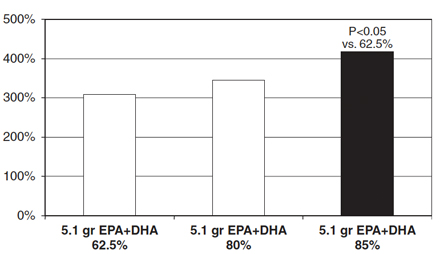
This is why it’s critical to take ultra-concentrated fish oil supplements that provide at least 80% Omega-3 concentrations.
It’s not just the AMOUNT of Omega-3 that matters, it’s the PURITY as well.
Why Didn’t the 62% Pure Fish Oil Work? |
| Technical Explanation of Study Results
The study authors think it’s because Omega-3 fats are a poor substrate for synthesis for triglycerides and Omega-3 also inhibit enzyme, acyl CoA:1,2-diacylglycerol acyltransferase due to the natural affinity Omega-3 has for this enzyme. This effect is enhanced because any oil that’s 85% EPA + DHA will likely be well over 90% in total Omega-3. This means there is very little, if any, other fatty acids. But the 62% pure oil had one-third non-Omega-3 fats. The ‘other’ non-Omega-3 fatty acids won’t react the same way with the acyl CoA enzyme. |
* These statements have not been evaluated by the Food and Drug Administration. This product is not intended to diagnose, treat, cure, or prevent any disease.

I wonder how this study has been conducted. I suppose that the explanation given
for the observed differences in tryglyceride levels only makes sense if the fish oil
has been administered on empty stomach? Considering all the fat a meal
contains, the few mg additionally taken in with 62% n-3 fish oil shouldn’t make
any significant difference. That’s interesting because I have read several times
that fish oil is better absorbed if taken in with a fatty meal. This study seems to
suggest the exact opposite!?
Hi Tim – you’re right, there are several studies that suggest fish oil is better absorbed with a fatty meal, especially if the oil is an ethyl ester. This study is somewhat puzzling from that perspective, but it is fairly well-designed. As far as the protocol used in this study, yes, the Omega-3 was dosed on an empty stomach but it was followed by breakfast…so it is an empty stomach or not? The study did not say how long the subjects waited before consuming breakfast.
– Vin Kutty
I have the same question as Tim. When one get 3 30% fish oil and another one get 1 90% fish oil(ensure that they got same omega-3 quantity), Considering all the fat in a meal contains, the few mg additionally taken in 30% fish oil subject. It will really have effect on omega-3 absorption?
Hi Eric – that is a good point. However the study that I discussed in this blog: http://www.omegavia.com/why-pharmaceutical-grade-fish-oil-is-better/ seems to argue that even though the TOTAL AMOUNT of Omega-3 is the same, the concentration of Omega-3 seems to make a difference in the eventual health outcome. The authors of that study suggest reasons for why this might be – and I’ve mentioned them in the article – but I’d like to see scientists explore this a little more.
My opinion is that if you do not have any metabolic issues (high triglycerides) or inflammation issues (high C-reactive protein), then you can probably substitute low potency Omega-3 pills for higher potency ones. Three 30% pills instead of 1 90% pill may work. But if you have metabolic or inflammation issues then you probably need 3000 mg of Omega-3 per day. Then the question is: are you still willing to take 9 to 12 30% pills per day. So even if the science in the study is proven wrong, it becomes a compliance and convenience issue because 1000 mg Omega-3 is a base maintenance dose for people without any health issues. Most of us are not that lucky.
Hi Vin, Very Informative and full of useful information on Omega’s and fish…
Question! I have 11 yr old who is hyper and lacks concentration. I was giving
him Nordic naturals omega and then I switched to Vegan omega, I did notice that it
does NOT work at all. Now I was searching for best omega for him and came across
your view on Krill.. so should I give him Krill and if yes then how many mgs… or can I
start him on your Omegavia. some time his mood feels down… since you mention
Omegavia has more EPA which is needed for mood .. so what do you say? krill or omegavia
and how many caps per day…
thanks you and best regards.
Hi Mohammed – I will say upfront that I have strong opinions about this. I usually talk people away from Krill oil unless they are aware of the dosage they are getting. You need 1000 to 2000 mg of EPA to help with mood issues. Let’s say Krill oil is twice as effective as fish oil. You’d still need 500 to 1000 mg of EPA from krill. Given that most krill oil pills have less than 50 mg of EPA per pill, you’d have to give your son 10-20 krill oil pills to get to this recommended dosage. At the same time. OmegaVia pills are a bit too large for a 11 year old. I suggest you look into something like OmegaBrite – it has one-third the Omega-3 of OmegaVia but it is a small pill that a child should be able to swallow.
– Vin Kutty
Somewhere I read that FOs are a corticosteroid. is that true?
Hi Bonnie – fish oils are not corticosteroids, although they may have an influence on steroids in the body.