


Is one better than the other? Or is it just nerdy hair-splitting?
I’ve had a few questions in my inbox about the difference between different types of fish oils.
No, I don’t mean Cod liver oil vs Salmon oil.
We’re talking molecular structure of the Omega-3 fatty acids.
We’ve talked quite a bit about the Phospholipid (PL) form of Omega-3 found in krill oil.
Ethyl Ester (EE) form and Triglcyeride (TG) form are the most common types of fish oils.
The TG form is naturally found in fish. But it can’t be concentrated. To produce an ultra-concentrated or pharmaceutical grade fish oil, it is necessary to convert the TG form into EE.
The science suggests that the PL form is likely the best absorbed of the bunch.
PL Omega-3 found in krill makes a lot of sense theoretically because that’s how Omega-3 is stored in our body. But krill oil is a very weak source of Omega-3. And it cannot be concentrated without destroying the PL-Omega-3 bond. If you heat krill oil, you destroy most of what’s good about it.
That’s why krill oil is concentrated (somewhat) using solvents like hexane or alcohol.
Still, there are slight differences in absorption between EE and TG forms of fish oil. Don’t think of this as two losers fighting for second place.
So…between TG and EE, which is better?
TG is a little better, in my opinion. But not much.
Scientific opinions vary.
See table below:
The Science Behind EE vs TG Absorption
Research Results are Mixed |
||
STUDY |
AUTHORS |
RESULT |
| #1 | Luley et al. | No difference between EE and TG. |
| #2 | Nordoy et al | No difference between EE and TG. |
| #3 | Krokan et al | No difference between EE and TG. |
| #4 | Hansen et al | No difference between EE and TG. |
| #5 | Harris et al | No difference between ME and TG. But both reduced blood triglyceride equally well. |
| #6 | Reis et al | No clear difference. |
| #7 | El Boustani et al | TG was slightly better. |
| #8 | Lawson & Hughes | TG was slightly better. |
| #9 | Dyerberg et al | TG was better. |
| #10 | Neubronner et al | TG was better. |
There’s one common element in all the studies where the researchers found no clear difference between EE and TG: study participants took the pills with their meals.
Specifically, the fish oil pills were taken in the presence of some dietary fat.
So if you take EE fish oil with your meals, you will dramatically increase its absorption, to the point that there is virtually no difference between the two forms.
This study showed that eating fish was the best way to get Omega-3 but there was a 3-fold increase in absorption of Omega-3 if fish oil pills were taken along with food.
OmegaVia uses EE fish oil.
This is why our dosage directions clearly say: BEST IF CONSUMED WITH A MEAL.
If taken on an empty stomach, TG is slightly better absorbed.
If taken with a full meal, TG and EE forms are almost equally well absorbed and the above advantage virtually vanishes.
Also, there are no reliable studies where EE dramatically outperformed TG.
Other than that, the differences are minor:
- TG tastes better than EE, if you want to drink liquid fish oil by the spoonful.
- TG is the natural form Omega-3, as it is found in fish.
- TG is slightly more resistant to rancidity.
These are clear benefits if you take liquid fish oil.
The Omega-3 Index
Of the list of studies in the table above, the best designed and most recent is the one by Neubronner et al.
Unlike the other studies, these scientists decided to measure the Omega-3 Index.
I’ll write more about Omega-3 Index at a later date, but in a nutshell, it measures the actual percent of Omega-3 that becomes a part of your red blood cell membranes.
An Omega-3 Index of 8 and above is considered low risk for disease. 4 to 8 is intermediate risk. Below 4 is high risk.
- Japanese are almost at 9. Not bad!
- Germans are at 6. So-so.
- Americans are, ahem, at 4.
In the study, BOTH EE and TG forms of fish oil were well absorbed and BOTH increased Omega-3 Index quickly and significantly after taking about 1,700 mg of Omega-3 per day.
The TG form did a slightly better job than EE form. See below.
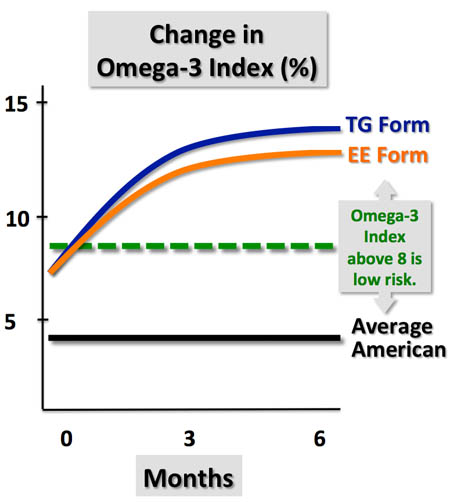
Adapted from Neubronner et al. Enhanced increase of omega-3 index in response to long-term n-3 fatty acid supplementation from triacylglycerides versus ethyl esters Eur J Clin Nutr 65 (2010) 247-254.
Both TG and EE forms of fish oil quickly got the participants from below an index of 8 to well above it. And it looks like it took less than 3 months to do so.
There was a 15% difference in Omega-3 index between TG and EE fish oils at the end of 6 months.
This tells me that the ‘biological outcome’ (translated to English, that means ‘the benefits to your health’) is virtually the same.*
In the authors words, the EE fish oil ‘highly exceeded’ the goal of getting the participants above an Omega-3 index of 8. They reached a very healthy index of 12.2.
Next…
- Is that 15% worth the extra cost of TG fish oil?
- Is all this just nerds splitting hairs?
- Is there any truth behind the internet fear-mongering?
*These statements have not been evaluated by the Food and Drug Administration. This product is not intended to diagnose, treat, cure, or prevent any disease.

comments 33 comments