
What else should I be taking besides fish oil?
This is a question posed to me almost daily.
Magnesium
Without knowing your diet, it’s hard to say, but I’m willing to bet that you’re borderline deficient in magnesium.
Vitamin D3
And by the end of winter, if you’re not taking Vitamin D pills, I’d also bet that your Vitamin D tank is runnin’ low. But we’ll deal with Vitamin D another day.
Vitamin K2
To help direct calcium in your bones and out of your arteries. Here’s an article on how to choose the right Vitamin K2.
Magnesium: Why Should You Take It?
Let’s talk about why you should take a Magnesium supplement.
How am I so sure that you’re magnesium deficient?
Well, about 70% of Americans don’t get enough Magnesium. Other estimates put it closer to 80%.
This deficiency is rampant. And dangerous.
You need about 400 milligrams (mg) of it everyday because your body uses it for 300+ different enzymatic reactions in your body. Some of these reactions produce energy and others control heart health.*
And due to heavy food processing, most of what we eat has been stripped of magnesium. So our diet is woefully low in magnesium.
A hundred years ago we got about 500 mg every day just from our diet. Now, we get just 150 mg.
It’s not just food processing. Other stuff reduces magnesium too:
- Soften your drinking water? Well, that gets rid of a bunch of magnesium.
- Drink coffee? That flushes some magnesium out of your body.
- Alcohol? Yup, blocks magnesium.
- Bunch of cardiac and insulin drugs can cause magnesium deficiency.
I could go on and on. You get the picture.
Three important benefits of Magnesium:
1. Heart health*
Magnesium is a natural calcium channel blocker.
This translates to: magnesium prevents excess calcium from entering the heart and blood vessels. This, along with a healthy diet and exercise, may help maintain healthy blood pressure.*
2. Cholesterol management.*
Magnesium when combined with a healthy diet and exercise plan may help maintain healthy cholesterol levels in your body.*
How?
Magnesium is necessary for an enzyme that helps the body process cholesterol properly.
Not too shabby for a lowly mineral.
3. Mood health*
Magnesium helps your nerve and muscle cells relax.
Got an eye twitch or muscle cramp?
Could be from low levels of magnesium. Of course, there are other reasons for these symptoms, but not having enough magnesium could be a big one.
Calcium makes muscles tight. And magnesium relaxes them. So it’s not surprising that people taking magnesium supplement experience better sleep.*
Books have been written about why you need more magnesium. So this is just a tiny taste of what it can do for you.
* These statements have not been evaluated by the Food and Drug Administration. This product is not intended to diagnose, treat, cure, or prevent any disease.
How to get more Magnesium?
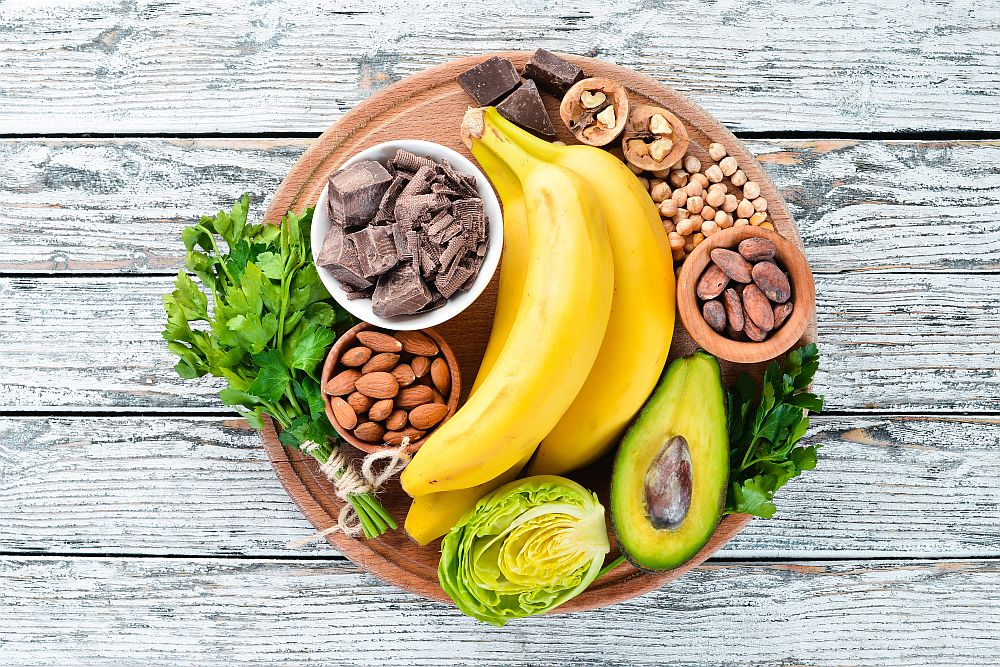
Eat more:
- Pumpkin seeds
- Almonds
- Leafy green veggies
Seaweed (kelp) has more than any of the above, if you can stand the taste. I can’t.
Before I go any further, I must warn you that if you take a lot more than 400 mg magnesium at a time, it may have a laxative effect. So, don’t get excited after reading this and take a bunch at once. You’ll be home-bound for at least half a day. Remember Milk of Magnesia? It’s just a high dose of Magnesium.
This is why I take a 200 mg pill twice a day.
Magnesium supplements are easily available at drug and grocery stores. But just like fish oil, the readily available stuff is cheap and you get what you pay for.
Most cheap drug store grade magnesium is made of Magnesium Oxide, which is not very well absorbed. It’s a little better than a pebble. You may be better off drinking tap water to get your magnesium.
If you want better absorbed magnesium, get magnesium glycinate, bisglycinate, or magnesium malate. These forms are far less likely to cause digestive distress.
Where to buy?
Not the grocery or drug store. You’re better off doing your homework online and buying from one of the reputable online retailer.
Common forms of Magnesium are not patented. Therefore, inexpensive. Given how deficient most of us are and how much it helps with several health conditions, it makes no sense not to supplement with it.
So is it as important as Omega-3? Yes. I occasionally skip my Vitamin D pill. But I rarely skip my Omega-3 or Magnesium.
Next up: Vitamin D3. And later, Vitamin K2.
Be sure to check out the Nutritional Magnesium Association’s web page. Tons of great info there. And look into Dr. Carolyn Dean’s book, Magnesium Miracle.
* These statements have not been evaluated by the Food and Drug Administration. This product is not intended to diagnose, treat, cure, or prevent any disease.


Thanks so much for your hugely informative articles! Have you written about Vitamin K yet? I’m really interested to read what you have to say about it.
Hi Stacy – yes, here: https://omegavia.com/how-to-choose-the-right-vitamin-k2-supplement/
Hello. I know I’m late to the game and this article was written a few years back now. However, I am the mom of a wonderfully, bright and fantastic nine year old boy who has been diagnosed early onset rapid cycling bipolar disorder, ADHD and tick disorder. Oh yes, triple whammy. He has taken medication since he was 5. After recently going thorough an awful attempt at a med change to better stabilize his disorder(s) sending him into a cycling mess for about two weeks, I have done more and more research on alternative therapies using supplements/vitamins. I have always trusted his dr’s as they know the disorder and treatment better than I do. I’m not a doctor and didn’t got to school for it. Without sounding too hardened, I’m quickly coming to the realization how much poison I am feeding in to my son with the “hopes” of helping him be able to cope day to day.
To get to my question: the two I consistantly see over and over are magnesium and omega-3 to assist in the treatment of bipolar disorder and ADHD. Have you seen/heard positive results to this as well? I do plan on discussing with his med mgmt dr but feel I need to be armed with some sort of facts as they aren’t always the most receptive group of folks.
Thanks so much.
Hi Concerned Mom – since you are dealing with a ‘triple whammy,’ I would get as educated about it as possible – you probably are.
I have heard from other customers about it – but that’s anecdotal evidence. As of now, there is no conclusive scientific evidence on Omega-3 and ADHD. To me, this is not as much a call for supplementation as is it for a drastic diet-correction. A back to basics, ancestral diet exclusively of whole foods (no sugar, no grains, no processed foods, no soda, no cereals, no UPC code anywhere in sight type diet) may help. Because of soil depletion, even if you son eats a lot of traditionally magnesium-rich foods, he may not be getting enough. So there is a good argument for magnesium supplementation. Omega-3, well, you should start with 10 oz of wild salmon per week.
Usually, I lose parents when I say the words ‘drastic diet correction.’ And that’s my cue to exit. Hope I didn’t do that with you.
I plan on taking this product for bone health.
Terry Naturally Osteo Strong: Which contains following.
Vit d – 4000 iu Manganese – 2 mg
Vit k1 – 300 mcg Copper – 2 mg
Calcium citrate – 450 mg Boron – 12.5 mg
Magnesium – 200 mg Vit k2 – 45 mcg
Zinc – 20 mg Silicon – 50 mg
What do you think about this supplement, formula and dosage?
Is the dosage too high for what you need in a bone health product?
Should I also take additional calcium (age 62) and vit k2?
Hi Betty – addresses most bone needs. I’d still take an additional magnesium and K2 supplement to make up for this formula’s deficiencies. I’d prefer a K2 supplement with both MK-4 and MK-7 and at slightly higher doses. I prefer 200 mcg of MK-7 instead of 45 mcg. I suspect they kept it low for cost reasons. But something is better than nothing. If you’re eating a healthy diet, most people don’t need additional calcium. If I formulated this product, I’d remove or reduce the calcium in half. Again, I suspect they put the calcium in the formula because it would not make sense to most people to buy a bone formula without calcium – that’s just consumer perception, not science. Note that you will have to take 4 pills to get the above levels…which means you’re only getting about 10 mcg of K2 per pill. Not enough if you decide you only want to take 1 pill per day.
Thanks so much for the information about the Naturally Terry’s bone health product (Osteo Strong). I agree on more Vit. k2 . What is your recommendation on dosage for magnesium and daily calcium intake (food or supplement)? I would like to know if zinc, copper, manganese, boron and silicon dosage in this product is on the high side (4 pills). I would like to take 2 pills daily with extra K2 and magnesium. Or should I take the 4 pills with extra K2 and magnesium?
Hi Betty – the micronutrients seem OK. I suggest you get 400 mg of magnesium from any source other than magnesium oxide. I usually don’t tell people to supplement with calcium – eating vegetables, meats, eggs and dairy (if you tolerate it) is usually sufficient. If you do want to supplement, calcium citrate is probably OK. Your idea of taking 2 pills per day with extra Mag and K2 is a good idea.
I forgot to ask : Is there any other supplements you would like to add for good bone health or suggest another product.
Your bones are pretty well covered. Next step: start reading up on gut health.
Hi Vin,
Does consuming magnesium l-threonate helps with supplementing ourselves with magnesium intake the same way as magnesium citrate and magnesium malate do? I’ve read a few articles about magnesium l-threonate and became very interested in its memory-improving function.
Does the different brands provide different quality? They have the same amount per serving.
Hi Ken – yes, Magnesium threonate provides some magnesium. It has been shown to provide benefits to the brain and some memory-related benefits. The problem is that the threonate salt is weak in magnesium. You will need to take a lot of pills to get your required dose. I suggest combing threonate with citrate, malate or glycinate forms to make up the shortfall.
Thanks for the reply. Wouldn’t have know that threonate salt is weak in magnesium without you! Would you be able to advise us if the different brands would have different qualities if they have the same amount per serving?
Hi Ken – impossible to tell – there are several brands that sell Mag threonate and they may have different amounts of active ingredient in each pill. Magnesium amount will be listed on the supplements facts panel on the side.
Hormone-D is a hormone (not a vitamin).
Synthetic D3 uses magnesium making one even more deficient. Magnesium can increase D. Also D3 requires A (in the form of retinol). Too much hype on hormone D.
Doctors need to test both storage and active D. I am actually over lab range for 1,25-D (aka calcitriol).
https://drive.google.com/folderview?id=0B7jisgqDxpL9RElVeWcyUnV4WXM&usp=sharing&tid=0B7jisgqDxpL9WkdhS1N4b1UweHM
“Magnesium plays an important role in helping your body’s Vitamin D status. Make sure your getting enough Maggie along with animal based Vitamin A throughout the day to raise your D naturally.”
my-magnesium.com/hormone-d.html
Hi SunnySky – I’m not clear on your point, but I see no issues (technically) with the statements. Yes, Magnesium, D, K2, A are all required and act together. I worry that doctors are telling people to take very high levels of D3 without telling them that they also need to consume the other nutrients. Excess D3 without the other cofactors can cause problems.
Hi Vin,
My 20 month old son might have ASD. Though hospital is still doing additional test, he displays a lot of symptoms. While still recovering from the shock and sadness with the news, I’m trying to find if there is some way to improve his condition via supplementation while working on Early Intervention.
I read some articles, including from Dr. Bernard Rimland that Magnesium and B6 may help on autism. Also found recently that magnesium l-threonate may be the best form for the brain, especially it inhibits DKK1. Not a scientist / researcher, in fact was struggling trying to decipher some of the scientific publications!
What I’m trying to find out is if there is any publication on dosage and safety of magnesium l-threonate and B6 P-5-P for 20 month old baby. The UL for Magnesium for 1-3 years old is 65mg for supplementation and 30mg for B6. I’m considering probably to start with 10 to 20mg of magnesium l-threonate and 10mg of B6 P-5-P, since both version of magnesium and B6 are the more potent form.
Any pointers would be deeply appreciated. I recognized these are just opinions and science are always evolving.
Thanks,
Hi Chris – a close relative of mine is going what you are, so I can imagine what you might be going thru.
There are several environmental and nutritional factors that seem to correlate with ASD, but no one has been able to come up with definitive causal factors yet. Having said that, both magnesium and B6 (actually all B vitamins) are critical for good health. It is a lot easier to incorporate magnesium supplement into the diet because many of the well absorbed forms are fairly benign tasting. Yes, the threonate form is well absorbed and there have been a couple of studies that support its use in brain health. But I don’t think you should focus on threonate. Any good source of powdered magnesium (bisglycinate, citrate, malate) is fine. Don’t get lost in the minor details. B6, on the other hand, is foul tasting and wont get a good response. I suggest looking up food sources of B6 that you can give your child. It will be difficult to get proper dosage levels for kids that young, this is another reason to rely on food. While you are at is, please read up on Vitamin D, probiotics, and prebiotic fibers as well.
Hi Vin,
Thanks so much on your comments.
Sorry to hear about your close relative. 🙁
Looking back I may have done some things differently. Lots of what-ifs and guilt going through my mind.
It is quite challenging to sieve out facts from marketing hypes, for a person not in food/supplement industry. Hence your insights are really valuable.
I have been taking Life Extension 160mg Mag Citrate Capsule and just tried putting a quarter of it on his water. He seems to have no issue with it. Will continue with it for now since i read some comments that Magnesium Bisglycinate powder has awful taste and the neutral taste version from Thorne is too expensive.
Just read about Vit D and autism. Going to try 800IU on my son (with some safety margin to 2500IU UL for his age)
Been reading abit on prebiotics and probiotics. May I know your take on Reuteri probiotics? There were some articles about Reuteri and ASD recently. Wonder does the different Reuteri strains matters? Some brands has Lactobacillus reuteri SD-5865. I’m thinking of giving him Nature’s Way which has Lactobacillus reuteri UALre-16. http://www.naturesway.com/Product-Catalog/Primadophilus-Reuteri-5-oz-Pwdr. This product comes with prebiotics, though not certain if that is sufficient.
Is Zinc-Carnosine useful or safe for baby over 1 years old? E.g. https://www.amazon.com/Doctors-Best-Zinc-L-Carnosine-Complex-Digestive/dp/B0035BYOSA?th=1
Or is this is another marketing hype?
Thanks!
Hi Chris – dwelling on what-ifs and the guilt that comes with it, is a natural step in the acceptance process. If you’re unable to shake off the what-if thoughts in the long-term, that won’t help a challenging situation. You and I are strangers and i have no business giving you advice, but remember this: it is not your fault.
On to things I know a little bit more about…
Magnesium. Try Natural Calm powders. It is in the Citrate form, so it is not offensive tasting. But go easy on the dosage. Citrate can still trigger a laxative effect if overdosed. Go easy and start small.
Vitamin D is critical, but know that it acts like a hormone. So, more is not better. There is an ideal level and if you overdose, you could have some side effects that could stick around for a couple of weeks. Talk to your pediatrician.
Yes, the Natures Way reuteri probiotic is good. I wouldn’t focus just on one bug. Kids with ASD typically have much lower gut bacteria diversity. This diversity becomes much harder to modify/increase after age 3 or so. So, act now. You improve diversity by taking antibiotics ONLY when absolutely necessary, by eating a lot of diverse (huge variety) vegetables that contains prebiotic fibers, by exposing yourself to nature, dirt/soil, animals, lakes, oceans, and more dirt/soil, by avoiding anti-bacterial soaps and cleaners. Once kids are 3 or 4, their probiotic fingerprints are somewhat set and established. Also, the amount of prebiotic fibers included in probiotic products are virtually useless and are added for marketing appeal. You need a LOT more prebiotic fiber than what’s in the Natures Way product.
I’d pass on the Zinc Carnosine.
Hi Vin,
Appreciate your insights! I’m now putting gut health a first priority for my son – to alleviate his condition as well as other health issues. Found out that those with ASD will also has high probability of major ailment, due to poor gut health.
It seems probiotics that we consume are transient in nature, I’m looking to bring him to more contacts with nature and animals.
On the topic of gut microbiome, what is your take on rebooting the gut? – both diet approach as well as fecal transplant?
Just started reading “Happy Gut” by Dr. Vincent Pedre and also researching more into fecal transplant – thanks for pointing that out in your other article.
I’m so thankful for internet. A wonderful medium for knowledge sharing. Without it I would not have the opportunity to learn from so many people around the world. Many whom I have not met.
Hi Chris – yes, gut health should be a focus for those with many health issues, including ASD. The information dust has a long way to go before it settles on ASD, but so far, gut microbiome, Vitamin D, environmental pollution are all factors that seem strongly linked to ASD. You MUST make a thriving and diverse microbiome a priority.
Yes, many probiotics are transient. That’s the way many are meant to be. Some take up permanent residency, as long as they are fed with prebiotic fiber. Rebooting gut with exposure to nature, diet, variety of fibers, etc are all easy to do. Fecal transplants have come a long way in the last 5 years. There are small studies showing benefits. But I cant help but wonder if the benefits would have been greater if the transplant was done in conjunction with a high prebiotic diet. You need to discuss with this an informed and competent functional medicine practitioner. There are pros and cons, obviously. Medial system is accepting of FT for antibiotic resistant C diff infections. But they are still not ready to do this for other health issues. Of course, then there is the issue of donor…what do you know about the true health of the donor? I think it is worth investigating FT, but the burden of choice will ultimately be between your pediatrician and your family.
My advice is to investigate with vigor and haste. There are forums for people who’ve been through the procedure.
I have my daughters who suffer from anxiety, they are 7 and 15 year old. As right now I give b complex, magnesium and omega3 to the 15 year old. And it seem to help and I give omega, and magnesium to the 7 year old but I don’t know if its working for her because one day she is ok and the next day can be very anxious. How much magnesium and omega3 do you reccomen for their ages?
Hi Isavel – while magnesium and Omega-3 may help a little, just those two alone is not enough. If you decide to use these two, aim for 400 mg of magnesium from magnesium malate and/or magnesium glycinate. And aim for 2000 mg of Omega-3 per day. You will need to focus on gut health – this is an area that is best handled with dietary modification. Switch from a grain-based diet to a vegetable based diet. The fiber in vegetables will help feed the mood-leveling good probiotic bacteria in the gut. This dietary change will help with mood. You may also want to consider adding some mood-support probiotics and prebiotic fiber from our sister company: https://innovixlabs.com/products/mood-probiotic and https://innovixlabs.com/products/broad-spectrum-prebiotic
Hi,
For a 4 years old kids, how much magnesium do they need? Is Solaray or KAL brand ok? Thanks
Hi Frank – for kids that young, I would aim for 50 mg per day but from vegetables. The two brands you mention are fine.
What about Magnesium Chloride which is found in the Concentrace Mineral Drops?
Hi Tera – magnesium chloride is very harsh on the gut. It is likely present in very small quantities in your liquid mineral product. That is why you are not experiencing severe gut issues, to put it mildly. If you took a couple of capsules of it, you’d be running to the bathroom!
Do not consider your magnesium needs met by the small quantity of magnesium chloride in the product you’re taking. Your best bets are Magnesium glycinate and Magnesium malate – our sister company makes a product with these two ingredients: https://innovixlabs.com/products/advanced-magnesium It’s also available on Amazon.
You could go with Magnesium citrate if cost is an issue, but citrate also has a mild laxative effect, so start with small quantities and work your way up. Overall, Magnesium citrate is a decent compromise between cost, absorption, and laxative effects…but you’ll have to figure out what you body can tolerate.