


Pharmaceutical Grade Fish Oil. What does that really mean?
First, here is what Pharmaceutical grade fish oil is NOT:
- It’s not an official FDA term
- It’s not a medical term
The term 'pharmaceutical grade' has become an unofficial measure of Omega-3 content.

Regular consumers have started using the word ‘pharmaceutical grade fish oil’ in everyday language. It is common parlance. But it’s a phrase that has been used by the folks in the fish oil industry for about two decades.
It's not the bread-n-butter fish oil sold at drug stores
This oil most people have been buying for a long time, the ‘bread-n-butter’ grade oil is called ‘18/12 oil’. Eighteen-twelve.
Most of the fish oil supplements are still 18/12 oils. It is a cheap commodity. It’s considered ‘entry level’ fish oil. In car terms, think Ford Escort. The quality of this oil can vary from excellent to scary.
What does ‘18/12’ mean?
Fish oil has two main types of Omega-3 fatty acids.
The two main Omega-3s in fish oil are EPA and DHA. They stand for Eicosapentaenoic acid and Docosahexaenoic acid respectively. In 18/12 oils, there is approximately 18% EPA and 12% DHA. Together, there is a total of 30% Omega-3. The other 70% is mixture of monounsaturated, polyunsaturated and saturated fats – stuff your body does not need more of.
So if you buy a brand that says ‘1000 mg Fish Oil’ on the label, chances are that it is an 18/12 oil. So 30% of the 1000 mg is Omega-3. That’s 300 mg. 180 mg of EPA and 120 mg of DHA.
For many years, almost all oils sold were 18/12 oils.
Then, roughly a decade or so ago, a couple of fish oil producers began making slightly more concentrated oil. It had 30% EPA and 20% DHA. They contained 50% Omega-3. As you would expect, we called it ‘30/20 oil’. This required a lot more work and purification. It was also a lot more expensive than the old 18/12 oil.
Since this new oil was much stronger, scientists had begun using 30/20 oil in human clinical trials. To justify charging a higher premium, clever fish oil marketers coined the term pharmaceutical grade fish oil.
That was almost 20 years ago, long before prescription fish oils existed.
30/20 oil is no longer considered very strong and 30/20 oil is no longer called ‘pharmaceutical grade’.
Why? Because there are much stronger oils available.
There is the 40/20 oil. And the 36/24 oil. Both contain 60% Omega-3. Some marketers call these oils pharmaceutical grade.
We don't agree. And most industry experts don’t consider 60% Omega-3 very strong.
As of this writing, there are ultra-concentrated fish oils with 85 to 90% purity.
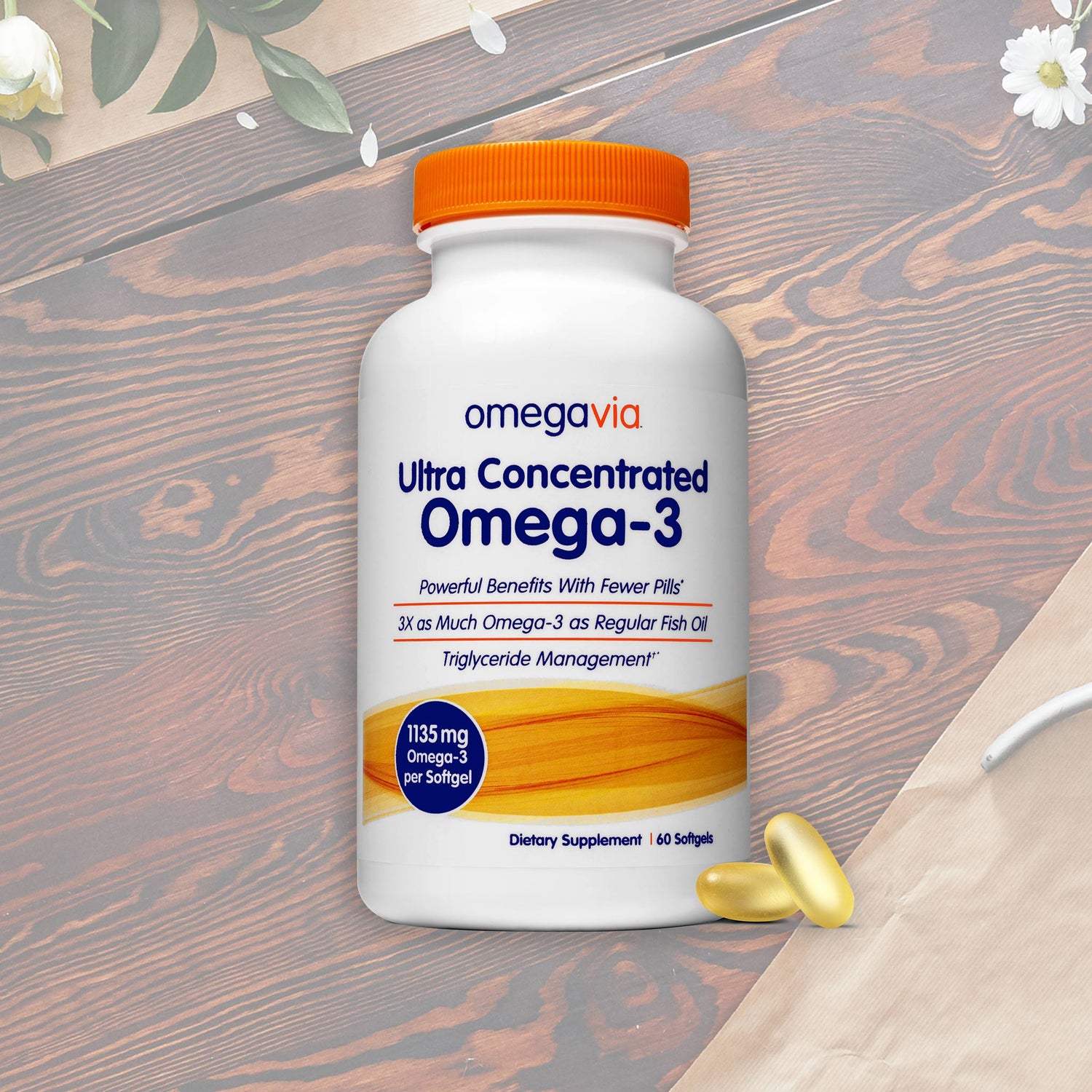
OmegaVia contains oil of this purity.
Features and benefits of pharmaceutical grade fish oil
- 85 to 90% Omega-3
- Only 10 to 15% non-omega-3 oils (as opposed to 70% in 18/12 oils)
- Easy to get high doses of Omega-3, like the dosages used in clinical studies
- Feel the benefits of fish oil with fewer pills
- Fewer pills to swallow
- Repeated purification steps and/or CO2 chromatography required to reach high Omega-3 concentration removes virtually all heavy metals like mercury
- Virtually no environmental toxins
- Ultra-purity reduces fishy odor
When you buy a pharmaceutical grade fish oil, you are not getting the old fish oil.
You're getting the best of what modern technology can offer for your health.
